


For most visits to Zagreb, a travel embedded Subscriber Identity Module (eSIM) installed before you fly is the least hassle, because you land connected without queueing at a shop or swapping the tiny plastic card in your phone. A local prepaid SIM card still wins in specific cases: a stay of a month or more, a phone with no eSIM support or a genuine need for a Croatian phone number that local businesses can call back.
The right answer depends on how long you are staying, where else you are going in Europe and what your home carrier already charges. Croatia joined the European Union (EU) in 2013, then adopted the euro and entered the Schengen area at the start of 2023, which changed the paperwork at the border but not the way mobile data is sold.
This guide walks through how mobile data works in Croatia, where and how to buy a local SIM, how a travel eSIM differs, an honest comparison of the 2 options and how to stay online while you actually enjoy Zagreb.
Choosing a Zagreb SIM card for tourists
Start with the length of your trip, since that single factor decides more than anything else. Short city breaks reward speed and simplicity. Longer stays reward a local number and local billing. Everything below assumes an unlocked handset, because a device still locked to your home carrier will refuse any other network.
- A weekend or a week: a travel eSIM bought before departure, active the moment you land.
- A month or longer: a local prepaid SIM from a national operator, topped up as you go.
- A multi-country European trip: a regional eSIM plan that follows you across borders.
- An older handset with no eSIM support: a physical prepaid SIM is your only real option.
- A work trip with a company handset: check whether your employer already has a roaming arrangement.
How mobile data works in Croatia
Croatia has 3 national mobile networks with dense coverage across Zagreb, strong service along the motorways and reliable signal in the Upper Town, the parks and the tram network. Modern speeds are available across the city, with older technology filling the gaps in rural inland areas. Whichever route you choose, your phone connects to those same physical networks. The difference is purely commercial.
If your plan comes from the EU
You are in the easiest position. EU rules on roam-like-at-home mean an EU plan generally works in Croatia at domestic rates, using your normal allowance. Check 2 details before you assume it: fair use policies can limit how much of your allowance is usable abroad over a long stay. Some low-cost domestic bundles also apply a separate roaming cap. Your carrier publishes both on its own tariff page.
Arriving from outside the EU
Here the maths changes. Carriers in the United Kingdom, the United States, Canada and Australia typically sell international access as a daily pass, a fixed data bundle or an inclusion on a premium plan. The price per gigabyte (GB) is usually far above what the same data costs locally. Some carriers still bill per megabyte if you have not opted in, which is how travellers end up with a shocking bill. Turn off Data Roaming for your home line before you land, then use whichever alternative you have chosen.
Buying a local prepaid SIM
Prepaid starter packs are sold by the national operators through their own shops, which cluster around Ban Jelacic Square and inside the larger shopping centres, plus newsstand kiosks across the city. Retail units at Zagreb Franjo Tudman Airport have sold them in the past, though availability changes, so do not build your arrival plan around finding a desk open at 23:00 Central European Time (CET).
Expect to show identification. Croatia follows the common European pattern where a passport is requested at registration before the assistant activates the card in the shop. Top-ups are sold as vouchers at kiosks, supermarkets and petrol stations. Each bundle carries a validity period, so a 30-day bundle bought on your last day is wasted money. The card takes your handset’s physical SIM slot, which means removing your home SIM and losing calls to your usual number unless your phone holds 2 cards at once.
How a travel eSIM works
An eSIM is a profile written into a chip already soldered inside your phone, so nothing physical changes hands. You buy the plan online, install the profile through an app or a Quick Response (QR) code, then switch your data line to it. Because installation happens over the internet, do it at home on your own Wi-Fi rather than hunting for signal at the airport.
The practical advantage is dual SIM behaviour. Your home number stays active for calls, bank codes and messages, while data runs over the travel profile. On both iPhone and Android you set this explicitly: choose the travel profile as your mobile or cellular data line, turn Data Roaming ON for it and leave Data Roaming OFF for your primary line. Check your model first on the Qrispy device compatibility checker, and confirm the menu path for your operating system on Apple support or Google support.
How the 2 options compare
Neither option is universally better. The table below sets out the trade-offs honestly, so you can match them to your own trip rather than to somebody else’s.
| Factor | Travel eSIM | Local prepaid SIM |
|---|---|---|
| Setup | Installed before departure, active on landing. | Bought in person after you arrive. |
| Phone number | Usually data only, home number retained. | Local Croatian number included. |
| Paperwork | None beyond the online purchase. | Identification is normally requested. |
| Device needs | Unlocked handset with eSIM support. | Unlocked handset with a physical slot. |
| Crossing borders | Regional plans continue working. | Roaming rules apply outside Croatia. |
| Best for | Trips of a few days to a few weeks. | Long stays and local calling. |
eSIM for Zagreb to stay connected
Public Wi-Fi is easy to find in cafes, hotels, museums and parts of the city centre. It is fine for maps or a menu. Treat it as a convenience rather than infrastructure: shared networks are a poor place to log in to a bank. A hotspot that vanishes when you leave the cafe is no use on a tram to Mirogoj. Mobile data is both safer and more portable, which is why the choice above matters.
Where Qrispy fits in
Qrispy is a global eSIM provider built around a single One eSIM you install once then keep on the device forever, covering 210+ countries and regions. Getting started takes under 3 minutes: choose a plan or top up on the web, install through the Qrispy eSIM app, then set it as your data line. For Croatia, the Global Wallet suits open-ended trips because credits never expire and the rate for Europe is set by destination and shown before you top up. A Fixed Plan of 3, 7, 15 or 30 days matches a set city break, while Unlimited Data Plans cover 90+ countries for 3, 7, 15 or 30 days, with fair use or temporary speed management during congestion.
Several details matter for a Zagreb trip specifically. Unlimited personal hotspot is included on every plan, so a laptop in a cafe on Tkalciceva runs off your phone without a second purchase. The Qrispy line carries data only, which is exactly why you keep your home SIM active alongside it. Smart IP Routing sends traffic out through the nearest Point of Presence (PoP), with Amsterdam and Paris closest to Croatia, so your Internet Protocol (IP) address may appear to sit in another European country, something worth knowing before you try a streaming login. Travel Buddy suggests routes around the Upper Town and out to Plitvice. Browse Qrispy eSIM plans for Croatia before you fly.
What to see while you are here
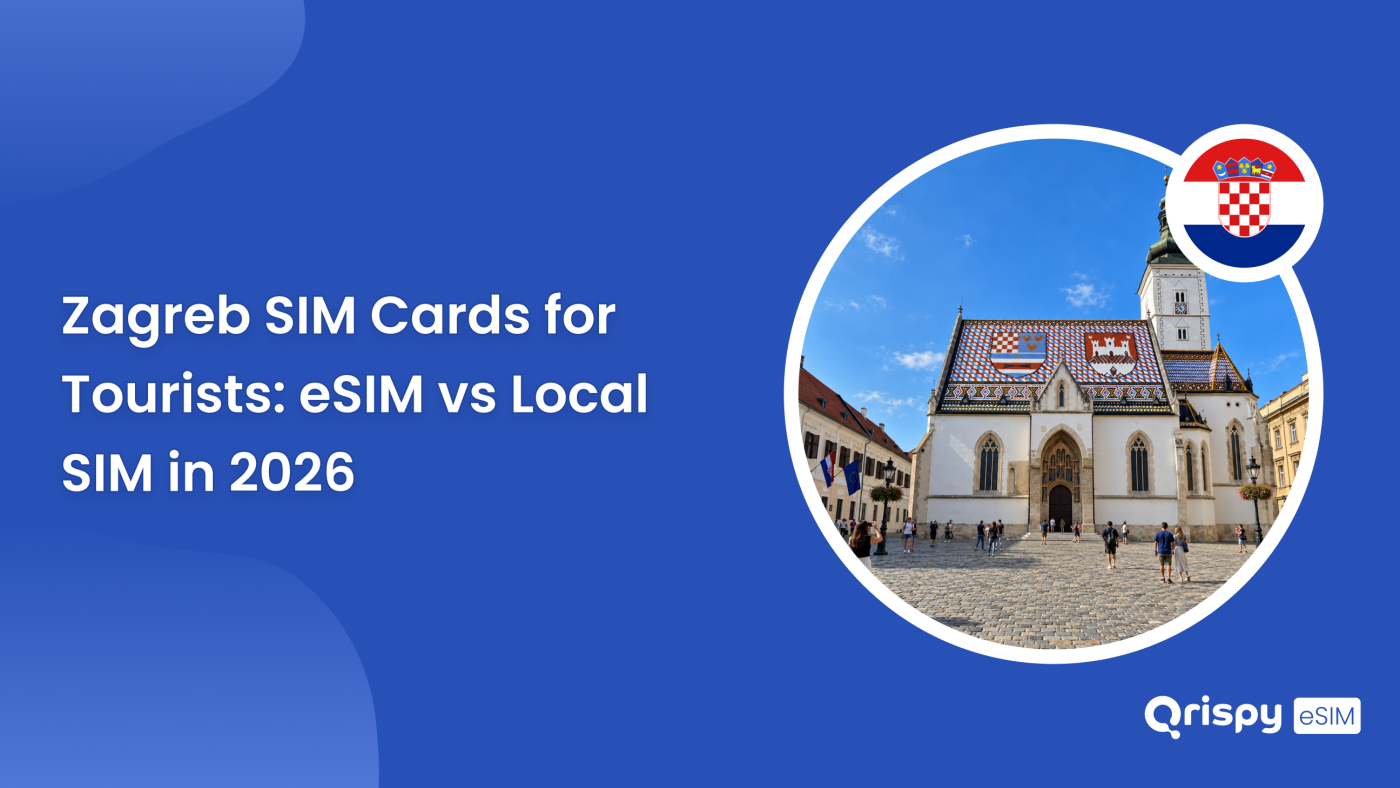
Zagreb divides neatly into an Upper Town and a Lower Town. Gornji Grad, the upper half, holds St Mark’s Church with its tiled coat-of-arms roof, the Stone Gate shrine set into a medieval archway, the Lotrscak Tower where a cannon is traditionally fired at midday and the short funicular that saves you the climb. The Museum of Broken Relationships sits up here too, far better than its gimmick suggests.
Down the hill, Ban Jelacic Square is the meeting point for the whole city, with the Dolac farmers market on the terrace directly above it under red parasols. The Lower Town follows a green horseshoe of parks and pavilions laid out in the 19th century, taking in the Botanical Garden and the Mimara Museum. Zagreb Cathedral has been under restoration since the 2020 earthquake, so check what is accessible. For air, head to Maksimir Park, the lakes at Jarun and Bundek or the ridge of Medvednica above the city.
Eating, drinking and getting around
Eat strukli, the baked or boiled dough-and-cheese dish that Zagreb treats as a birthright, ideally in its bubbling baked form. Sarma appears in winter, turkey with mlinci is the Sunday classic and burek from a bakery solves any breakfast. Dolac is the place to graze on cheese, honey and seasonal fruit. Coffee is a social institution here. The long Saturday morning ritual on the terraces off the main square has its own name, the spica.
Getting around is simple, because blue ZET trams cover the centre and run through the night on a reduced network. Buy a ticket before boarding where possible and validate it on board. From the airport, a shuttle bus runs to the main bus station and a public bus line serves the eastern side of the city, while taxis and ride-hailing apps work from the terminal. The centre itself is walkable end to end.
Practical basics for your trip
Croatia uses the euro and cards are accepted almost everywhere, though a market stall at Dolac may prefer cash. Tap water is safe to drink. Rounding up or leaving about 10% covers tipping when service has been good.
- Croatian is the official language, with English widely spoken by younger residents.
- Sockets take the round 2-pin Type C or Type F plug at 230 volts.
- The emergency number is 112 for police, ambulance and fire.
- Clocks follow CET in winter and Central European Summer Time (CEST) in summer.
- Official trip planning sits on the Croatian national tourist board site.
Frequently asked questions
Do you need a SIM in Zagreb?
Not always. If your mobile plan comes from another EU country, roam-like-at-home rules usually let you use your normal allowance in Croatia at no extra cost. Travellers from outside the EU generally do need an alternative, because their carriers sell international access separately and the premium over local rates is significant.
Where can you buy a SIM?
Local prepaid packs are sold in operator shops around Ban Jelacic Square, inside the larger shopping centres and at newsstand kiosks across the city. Airport retail has stocked them in the past, though availability varies by hour and by season. A travel eSIM avoids the question entirely, since you buy and install it before you leave home.
Does an eSIM include a phone number?
Usually not. Most travel eSIM plans, including Qrispy, provide data only rather than voice or text, which is why you keep your existing SIM active in the phone for calls and security codes. Messaging and calling apps such as WhatsApp and FaceTime work perfectly well over that data connection.
Is public Wi-Fi safe in Zagreb?
It is fine for browsing, maps and reading a menu. Shared networks in cafes, stations and hotels are a poor place to access online banking or work systems, because you cannot verify who else is on them. Mobile data gives you an encrypted connection of your own, which is the safer default for anything sensitive.
Will your phone work in Croatia?
Yes, provided the handset is unlocked and supports the local network bands, which almost every phone sold in the last decade does. The 2 things worth checking before departure are whether your device supports eSIM at all and whether your home carrier has locked it, since a locked phone rejects every other network.
Stay connected anywhere with Qrispy eSIM
Stay connected in 210+ countries with Global Wallet, Fixed Plans and Unlimited Data. No contracts, no roaming fees, no expiry. Download the Qrispy eSIM app today and start your journey.

Croatia Plans
Prepaid data plans for planned stays
Loading pricing plans...