


You have landed at Ninoy Aquino International Airport (NAIA) with hours to fill before an island flight. The question is simple: stay put or go out. The honest answer turns on 2 things, how long your connection really is once immigration is cleared and which terminal your next flight leaves from. Under 6 hours you stay close. Over 12 and you can walk Intramuros, eat your way through Binondo and still make the gate comfortably.
Manila does not give itself up easily on a short visit. Traffic is the great variable, the airport spreads across separate terminals with no airside link joining all of them and the run into the historic centre can take anything from half an hour to well over an hour depending on when you travel.
This Manila layover guide splits the day into the brackets that matter: under 6 hours, 6 to 12 hours and 12 to 24 hours. It covers leaving the airport, moving between terminals, what is genuinely worth your time in each window, what to eat and how to keep a live connection so your ride-hailing app works when you need it most.
Manila layover guide at a glance
Work backwards from your departure rather than forwards from your arrival. Budget time for immigration on the way in, for the terminal transfer if you need one and for a traffic cushion that Manila will happily use up. The table below is the shape most travellers end up with.
| Time in hand | Realistic plan |
|---|---|
| Under 6 hours | Stay in the terminal or cross to Newport City. |
| 6 to 12 hours | Intramuros plus Binondo, then the National Museum complex. |
| 12 to 24 hours | Add Makati or Bonifacio Global City plus a hotel night. |
| Overnight only | Sleep near the airport in Newport City or Paranaque. |
Can you leave the airport?
Yes, if your passport qualifies for visa-free entry or you hold the right visa. Many nationalities can enter the Philippines without applying in advance for a short tourist stay, though the list changes, so check the Bureau of Immigration before you count on it. You clear immigration like any other arriving passenger, which means the queue is part of your layover maths.
Your ticket structure matters just as much. On a single through-booking your bags usually travel to the final destination and you keep the transfer simple. Booked on separate tickets, you collect your luggage, clear customs, then check in again at whichever terminal your island flight uses. That process alone can eat a couple of hours at a busy time.
Getting between NAIA terminals
NAIA uses several terminals spread around the runway complex rather than a single building. Terminal 3 is the newest and handles a large share of budget carriers heading to the islands. Terminal 2 has long been associated with Philippine Airlines. Terminal 1 takes many foreign international arrivals. Assignments have been shifting, so confirm your terminal on your booking rather than on memory. A shuttle links the terminals for connecting passengers, but it runs on public roads, so treat any transfer under 3 hours as tight.
Under 6 hours: stay close
Do not go into the city. With less than 6 hours between flights you spend most of it in traffic worrying about the return leg. Terminal 3 gives the best options, with restaurants, massage chairs and a cluster of food outlets. A covered walkway crosses from Terminal 3 towards Newport City, where hotels and Filipino restaurants sit within a short stroll. Book a day-use room if you want a shower before a night flight to Siargao or El Nido.
6 to 12 hours: Intramuros and Binondo
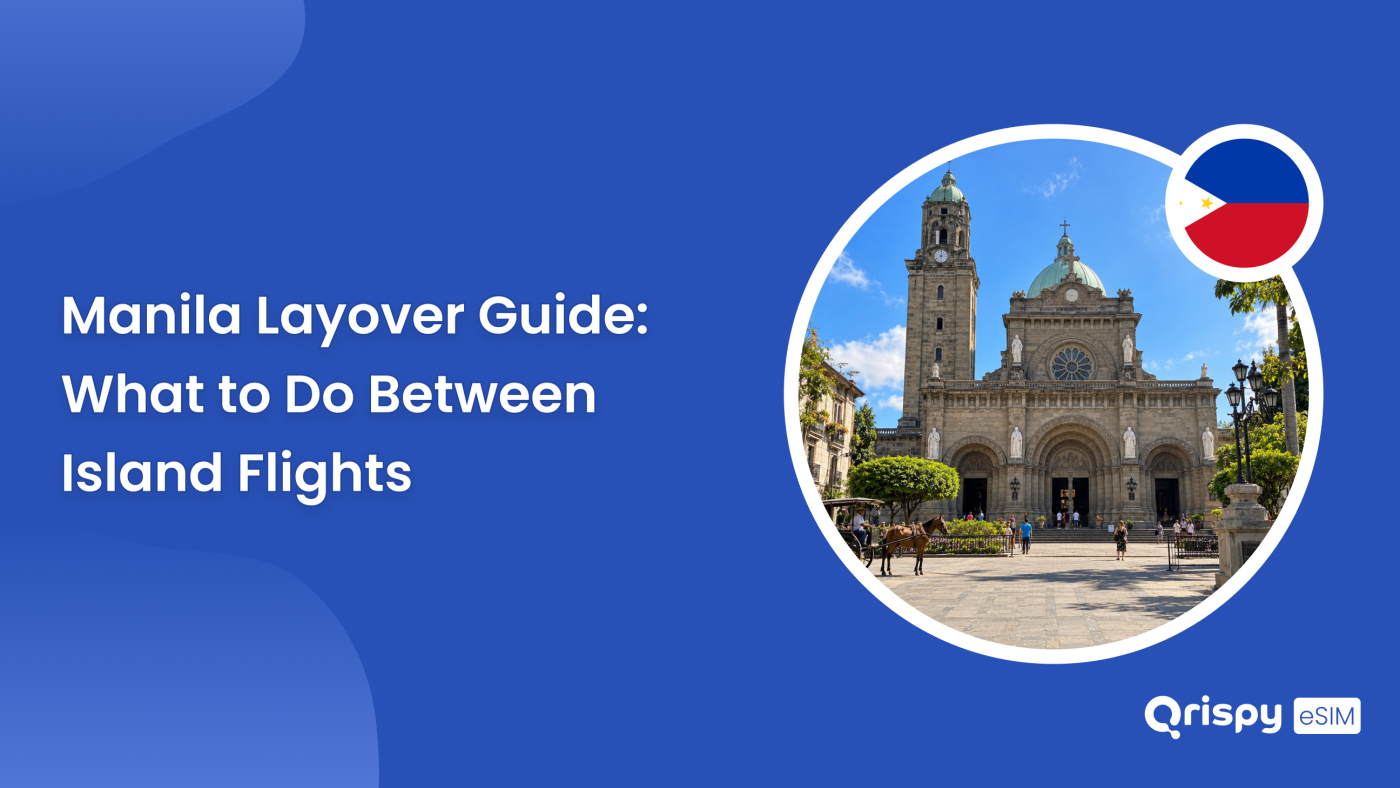
This is the sweet spot. Take a ride-hailing car to Intramuros, the Spanish walled city that gave Manila its name. Start at Fort Santiago, where Jose Rizal spent his final night before execution in 1896. San Agustin Church nearby is a World Heritage Site and the oldest stone church in the country. Casa Manila shows how a wealthy colonial household lived. You can walk the ramparts in an hour.
Binondo, a short hop north across the Pasig River, claims the title of the oldest Chinatown in the world. Ongpin Street is the spine, Binondo Church anchors the plaza and the eating is relentless: fried siopao, hopia, hand-pulled noodles and dumplings in the alley kitchens around Estero. If museums appeal more, the National Museum complex beside Rizal Park holds the Spoliarium by Juan Luna in a grand neoclassical hall.
12 to 24 hours: go further
With a full day you can add a second district. Makati offers the Ayala Museum, the Greenbelt gardens and Poblacion after dark, where old townhouses have turned into small bars serving Filipino craft gin. Bonifacio Global City, usually shortened to BGC, is the newer, cleaner counterpoint: wide pavements, large murals and the Mind Museum. Both sit closer to the airport than Intramuros does.
Sunset over Manila Bay from Roxas Boulevard is the classic close to a stopover. If you have a genuine 24 hours and an early start, the ferry to Corregidor Island turns the day into a serious excursion around Second World War fortifications, though it commits you completely. A room booked near the airport rather than downtown protects your morning flight.
Getting into the city
There is no rail link from the terminals, so everything starts on the road. Ride-hailing through Grab is what most residents use, with marked pickup bays at each terminal. Official airport taxis queue outside arrivals in colour-coded lanes. Point-to-point buses run set routes to Makati and other hubs for less money.
Grab is the default because the fare is agreed in the app before you set off, removing any negotiation at the kerb. Airport taxis are fine from the official rank rather than from someone approaching you in arrivals. Point-to-point buses suit solo travellers heading to Makati. The Light Rail Transit (LRT) and Metro Rail Transit (MRT) lines exist, though reaching a station needs a road hop.
What to eat on a layover
Filipino food rewards a short visit because the greatest hits are quick. Sisig arrives on a sizzling plate, chopped pork with calamansi and chilli. Adobo is the national braise of vinegar, soy sauce, garlic and pepper. Kare-kare is oxtail in peanut sauce with shrimp paste on the side. For dessert, halo-halo is shaved ice layered with beans, jellies, leche flan and ube, eaten by stirring everything together.
Beyond those, lechon is the slow-roasted pork with crackling that Filipinos rate above everything else, while pancit and lumpia are the noodles and spring rolls on every menu. Taho, warm silken tofu with syrup and tapioca, is sold by street vendors early in the morning. None of it needs a reservation, which suits a layover.
Practical basics for a Manila stopover
The currency is the Philippine peso (PHP). Cards work in malls, hotels and chain restaurants while jeepneys, market stalls and small eateries want cash, so draw some at an automated teller machine (ATM) in the terminal. English is an official language and is spoken almost everywhere, which makes Manila among the easiest Asian capitals to navigate on a short stop. Filipino is the other language, so salamat for thank you goes down well.
Sockets take flat American style pins, though the supply is the higher voltage used across most of Asia, so check your charger before plugging in anything without a dual-voltage rating. The emergency number is 911. Service charge is often added in restaurants, with small change left on top when the service deserves it. The rainy season runs roughly from June to November, with typhoons most likely between July and October, which is worth knowing when your onward flight is a small aircraft to a small island.
Safety and common layover mistakes
Manila is manageable if you take the same precautions you would in any large capital. Petty theft is the realistic risk rather than anything worse. Keep your phone out of sight on the street, use the official taxi rank instead of accepting an offer in the arrivals hall and never let an unofficial porter walk off with a bag. The bigger mistakes are logistical.
- Underestimating traffic, which can double any journey without warning.
- Forgetting that a terminal change is a road trip, not a corridor walk.
- Assuming bags transfer automatically when flights are on separate tickets.
- Leaving the return trip until rush hour on a weekday evening.
eSIM for Manila to stay connected
A layover is exactly when connectivity stops being optional. You need a working data connection to book a Grab, to read the terminal transfer instructions, to check whether your island flight has slipped and to tell someone where you are. Terminal Wi-Fi exists but is patchy at busy periods, so treat it as a bonus rather than a plan.
| Option | What to expect on a stopover |
|---|---|
| Airport Wi-Fi | Available in the terminals, variable at peak times and unencrypted. |
| Local SIM card | Sold at arrivals with passport registration, which costs you queue time. |
| Carrier roaming | Instant, at a clear premium. Check your daily pass terms before flying. |
| Travel eSIM | Installed before departure and live the moment you land. |
For a stop measured in hours, the queue is the deciding factor. Buying a local card means finding the counter, showing your passport, waiting for registration and hoping the process finishes before your transfer window closes. An embedded SIM (eSIM) skips all of that because you install the profile at home over Wi-Fi and it activates when the aircraft doors open.
The Qrispy One eSIM installs once, stays on your device permanently and works across 210+ countries and regions, which suits island-hopping trips that touch several countries in a fortnight. You have 3 ways to pay on the same profile.
- Global Wallet is pay as you go, with credits that never expire and rates that vary by destination, shown before you confirm.
- Fixed Plans are prepaid for 3, 7, 15 or 30 days in a single country or region.
- Unlimited Data Plans cover 90+ countries for 3, 7, 15 or 30 days, with fair use or temporary speed management during congestion.
Set Qrispy as your mobile data line while your home SIM stays active for calls and one-time passcodes, then turn Data Roaming on for Qrispy and off for the primary line. The Qrispy line carries data only, so calls run over Wi-Fi Calling or apps such as WhatsApp. Unlimited personal hotspot is included on every plan, which matters when a travel companion runs flat mid-transfer. Travel Buddy, the in-app assistant, is useful for sketching a route between Intramuros and Binondo when your window is tight.
Check your handset first on the Qrispy device compatibility checker if it is more than a few years old, then choose from Qrispy eSIM plans for the Philippines before you fly. The Philippine Department of Tourism is the official source for anything you want to confirm about the islands beyond Manila.
Frequently asked questions
Can you leave the airport?
Yes, provided you qualify for visa-free entry or hold the right visa, since you clear immigration as a normal arriving passenger. Check the Bureau of Immigration for your nationality before you plan anything. Factor the arrivals queue plus the return security check into your timings rather than counting the full gap.
How long a layover do you need?
Roughly 6 hours is the minimum for a city trip, since immigration, traffic in both directions and the return check-in swallow most of a shorter gap. With 8 to 10 hours you can see Intramuros properly. Under 6 hours, stay in the terminal or cross to Newport City instead.
Is Intramuros worth a short visit?
Yes. The walled city is compact enough to cover on foot, with Fort Santiago, San Agustin Church and Casa Manila within a few minutes of each other. A bamboo bike or a walk along the ramparts fills a couple of hours easily, which fits neatly into a mid-length stopover.
How do you get between NAIA terminals?
A shuttle service links the terminals for connecting passengers, though it uses public roads rather than an airside corridor. Ride-hailing and airport taxis do the same job. Because traffic controls the timing, treat any terminal change as a road journey rather than a walk between gates.
Is Manila safe for a stopover?
Yes, with normal city precautions. Petty theft is the realistic concern rather than anything more serious, so keep your phone away on the street, use official taxi ranks or a ride-hailing app and watch your bags at the terminal. Sticking to Intramuros, Binondo, Makati and BGC keeps you on well-travelled ground.
Do you need cash in Manila?
Yes, some. Malls, hotels and chain restaurants take cards, while jeepneys, market stalls and small eateries in Binondo run on pesos. Draw cash at an airport machine before you head out, keep small notes for short journeys and avoid arriving in Chinatown with nothing but a card.
Stay connected anywhere with Qrispy eSIM
Stay connected in 210+ countries with Global Wallet, Fixed Plans and Unlimited Data. No contracts, no roaming fees, no expiry. Download the Qrispy eSIM app today and start your journey.

Philippines Plans
Prepaid data plans for planned stays
Loading pricing plans...