


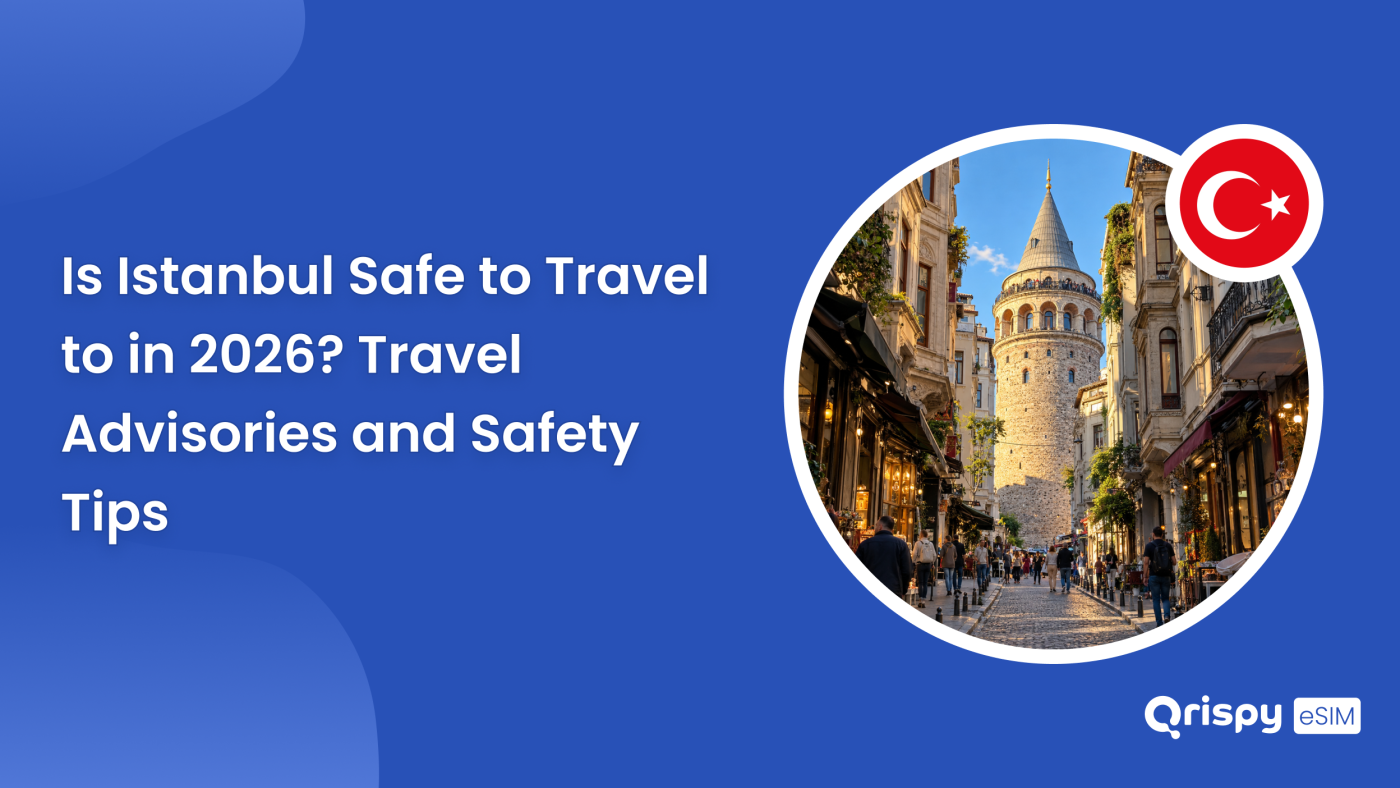
Yes, Istanbul is safe to travel to for the overwhelming majority of visitors. It stays safe with the same street sense you would use in any city of 15 million people. The realistic risks here are petty theft in crowded places, overcharging aimed at tourists, chaotic traffic and the background seismic risk that comes with the geography. Violent crime against visitors is rare.
That answer needs detail, because “safe” depends on where you go, when you go out and how you move around. A first-timer staying in Sultanahmet has a different risk picture from someone renting a flat in Kadıköy for a month.
This guide covers what national travel advisories actually say, the specific tricks worked on tourists, which districts feel comfortable after dark, what earthquake preparedness means in practice and how to keep a working data connection so that maps, translation and your ride app never leave you stranded.
Is Istanbul safe to travel in 2026?
Yes. Istanbul remains among the most visited cities in the world and the tourist corridor between Sultanahmet, Eminönü, Karaköy and Beyoğlu is busy late into the evening. Tourism is a major part of the local economy, so the historic areas are heavily policed and well lit.
Honesty matters more than reassurance, though. Türkiye sits in a complicated region, the political temperature can rise quickly and demonstrations do happen in central districts. Istanbul also lies close to the North Anatolian Fault, so earthquakes are a genuine part of life. None of this makes the city unsafe to visit. It makes preparation worthwhile.
Think of your risk in 3 layers: everyday petty crime, which you manage with habits; disruption such as protests or transport strikes, which you manage with information; and low-probability events such as a significant earthquake, which you manage by knowing what to do.
What travel advisories actually say
Governments publish country-level advice rather than city-level verdicts, so read them carefully. The United Kingdom Foreign, Commonwealth and Development Office, the United States Department of State and Australia’s Smartraveller all maintain pages for Türkiye that are updated when circumstances change.
The pattern in recent years has been consistent. Advisories single out the provinces along the Syrian border in the far south east, which sit roughly 1,200 kilometres from Istanbul, while advising normal increased caution elsewhere because of terrorism risk. Istanbul itself is not usually placed in a do-not-travel category, though advisories routinely tell travellers to avoid demonstrations.
Check the source rather than a summary. The official pages are gov.uk foreign travel advice and travel.state.gov. Both let you subscribe to updates for the country you are visiting. Your travel insurance may reference this wording, which is a practical reason to read it before you fly.
Crime in Istanbul and common tricks
Crime in Istanbul that affects visitors is overwhelmingly opportunistic rather than violent. Pickpocketing concentrates where crowds and distraction meet: the T1 tram between Sultanahmet and Eminönü, the entrances to the Grand Bazaar and the Spice Bazaar, Istiklal Caddesi on a weekend evening and the crush around Taksim Square.
Then there are the set pieces, worked on tourists for decades and easy to spot once you know them.
- A friendly man strikes up a conversation near Taksim or Istiklal and suggests a bar, where the bill arrives wildly inflated.
- A shoeshine drops a brush in front of you, then insists on a paid shine when you hand it back.
- A taxi driver claims the meter is broken, quotes a flat fare or takes a long route through traffic.
- A carpet or leather shop offers a free lift and a tea, followed by heavy pressure to buy.
- An exchange office advertises a strong rate on the window, then applies a commission at the counter.
Countermeasures are simple. Keep your phone and wallet in a front pocket or a zipped bag, never a back pocket. Agree a price before any service starts. Decline invitations from strangers to unnamed venues. Use an official exchange office or a bank rather than a street changer. Above all, walk away early: nothing here escalates if you do not engage.
Which districts feel comfortable
Sultanahmet is the historic core and the most watched part of the city, though it empties of residents at night. Beyoğlu, Galata and Karaköy stay lively until late and are comfortable to walk. Cihangir and Nişantaşı are residential and calm. Across the Bosphorus, Kadıköy and Moda have the best night-time atmosphere in the city and a large student population, while Üsküdar is quieter and more conservative.
Balat and Fener reward a daytime wander for their painted houses and steep lanes. As anywhere, use more care after dark in the transitional streets around Tarlabaşı, Dolapdere, Aksaray and parts of Laleli, where side streets get poorly lit and quiet quickly. This is normal big-city advice rather than a warning to stay away.
Earthquakes and what to do
Istanbul sits near the North Anatolian Fault and the seismic risk is real, which is why building codes were tightened and a retrofitting programme runs across the city. Modern hotels are generally built to current standards. Older buildings in dense neighbourhoods are the concern that engineers talk about publicly.
Preparation takes 10 minutes. Note where the stairs are in your accommodation, keep shoes and a torch by the bed, then learn the drill: drop, cover and hold on, then move away from the building once shaking stops. Never use a lift during or after a tremor. The national authority for disasters is AFAD, whose guidance sits at afad.gov.tr. The emergency number across Türkiye is 112.
Getting around safely
Public transport is the safest and fastest way to move. Buy an Istanbulkart from a machine at any metro or tram station, load it and use it on the metro, the T1 tram, the Marmaray tunnel under the Bosphorus, the funiculars, city buses and the ferries. Ferries between Eminönü, Karaköy, Kadıköy and Üsküdar are also the cheapest sightseeing in the city.
Taxis are where visitors most often feel taken advantage of. Order through a ride-hailing app so the route and fare are recorded. Failing that, use a hotel taxi rank and insist the meter runs. From Istanbul Airport the M11 metro connects to the wider network, while Sabiha Gökçen on the Asian side links through the M4. Havaist coaches serve both airports.
Traffic is the everyday hazard nobody warns you about. Drivers rarely stop for pedestrians at unsignalled crossings, so cross with locals and treat zebra markings as decoration rather than protection.
Advice for solo and women travellers
Istanbul is a common destination for solo travellers, including solo women. Most report a positive experience. Staring and occasional unwanted comments do happen, more so in conservative districts and less so in Kadıköy, Beşiktaş or Beyoğlu. A firm, unsmiling refusal is understood everywhere.
Dress is relaxed in most of the city, though mosques require modest clothing, shoes off and a headscarf for women, with visits best made outside prayer times and away from Friday midday. Share your location with someone at home when you go out late, keep your accommodation address written in Turkish, then prefer licensed transport at night over unfamiliar back streets.
Health, water and food
Tap water in Istanbul is treated and used for washing and cooking, but most residents drink bottled water because of the taste and the age of some building pipework. Street food is generally excellent: a simit from a cart, a balık ekmek fish sandwich at Eminönü, kokoreç, döner or a plate of mezes in a meyhane. Use the usual judgement about busy stalls with high turnover. Be cautious with midye dolma, the stuffed mussels sold on the street, in hot weather.
Pharmacies, marked eczane, handle minor problems and a duty pharmacy in each district stays open overnight on a rota. Private hospitals in the city have international patient departments. Make sure your travel insurance covers treatment in Türkiye.
Practical safety basics
- The emergency number is 112 for police, ambulance and fire.
- Currency is the Turkish lira, with cards widely accepted in shops and taxis.
- Sockets are the European 2-pin type C and type F at 230 volts.
- Carry a copy of your passport and keep the original in the room safe.
- Avoid demonstrations and crowds around political gatherings, which can be dispersed quickly.
- Photographing military and police installations is prohibited, so put the camera away near them.
- Learn 2 phrases: merhaba for hello and tesekkur ederim for thank you.
eSIM for Istanbul to stay connected
A working data connection is a safety tool in a city this size. It gets you a metered ride instead of a negotiated fare, a translated conversation at a pharmacy, a live map when a street closes for a demonstration and a way to reach an official emergency line or your embassy. Losing signal in Istanbul is an inconvenience on holiday and a real problem in an incident.
Device registration is the local detail worth planning around. Türkiye operates a registration system for handsets used with a Turkish SIM card. An unregistered phone can lose service after a set period unless it is registered with the authorities, which involves a fee. Rules change, so check the current position before you decide to buy a local SIM.
How the connectivity options compare
| Option | Best for | Watch out for |
|---|---|---|
| Public Wi-Fi | Hotels, cafes and airports | Open networks are poor for banking and logins |
| Local SIM card | Long stays needing a Turkish number | Device registration rules and passport paperwork |
| Carrier roaming | Doing nothing before you fly | Non-EU zone pricing and unpredictable bills |
| Travel eSIM | Landing already connected | Needs an unlocked, compatible phone |
Where Qrispy fits
An embedded SIM (eSIM) is a profile you download instead of a chip you queue for, so you land at Istanbul Airport already online. The Qrispy One eSIM installs once and stays on your device for good, covering 210+ countries and regions. Feed it whichever way suits the trip: the Global Wallet is pay as you go with credits that never expire, Fixed Plans are prepaid for 3, 7, 15 or 30 days and Unlimited Data Plans cover 90+ countries, with fair use or temporary speed management during very heavy use. Start with the Qrispy eSIM for Türkiye and install before departure, since activation needs an internet connection.
Keep the setup simple once you arrive. Your primary SIM stays active for calls and one-time passcodes from your bank, Qrispy becomes the mobile data line with Data Roaming switched on for it. Multi-network access moves you to whichever local network is strongest as you cross between the European and Asian sides. Unlimited personal hotspot is included on every plan, which matters if you are travelling with someone whose phone has no data. Mobile data is also safer than an open cafe network for banking. Travel Buddy in the app is useful here for local safety guidance, transport routes and quick Turkish phrases. The eSIM data usage calculator will tell you roughly how much data a week of maps and messaging needs.
Frequently asked questions
Is Istanbul safe for tourists?
Yes. Istanbul is safe for tourists who take normal city precautions. Violent crime against visitors is rare, while pickpocketing in crowded areas and overcharging by taxis or bars are the everyday risks. Stick to busy, well-lit streets at night, agree prices in advance and keep valuables out of back pockets and open bags.
Is Istanbul safe for solo women?
Mostly yes, with awareness. Many women travel Istanbul alone without incident, though staring and unwanted comments occur, particularly in conservative districts. Choose accommodation in Beyoğlu, Kadıköy, Beşiktaş or Nişantaşı, use ride-hailing apps after dark rather than walking unfamiliar back streets. Dress modestly for mosque visits. A firm refusal is understood everywhere.
Which areas should you avoid at night?
No district is off limits, but use extra care after dark around Tarlabaşı, Dolapdere, Aksaray and quieter parts of Laleli, where side streets are poorly lit. Sultanahmet empties of residents once the sites close. Kadıköy, Beşiktaş, Karaköy and Galata stay busy late and generally feel comfortable for walking.
Is tap water safe to drink?
Tap water is treated and fine for brushing teeth, washing and cooking. Most residents still drink bottled water because of the taste and older plumbing in some buildings. Bottled water is cheap and sold everywhere, so do as locals do. Refill points are uncommon, which is worth knowing if you carry a reusable bottle.
Do earthquakes make Istanbul unsafe?
No, though the risk is genuine and worth preparing for. Istanbul lies near the North Anatolian Fault, so building standards were tightened and retrofitting continues. Choose accommodation in a modern building, note the stairs and learn to drop, cover and hold on. Follow AFAD guidance and keep the emergency number 112 to hand.
Stay connected anywhere with Qrispy eSIM
Stay connected in 210+ countries with Global Wallet, Fixed Plans and Unlimited Data. No contracts, no roaming fees, no expiry. Download the Qrispy eSIM app today and start your journey.

Türkiye (Turkey) Plans
Prepaid data plans for planned stays
Loading pricing plans...