


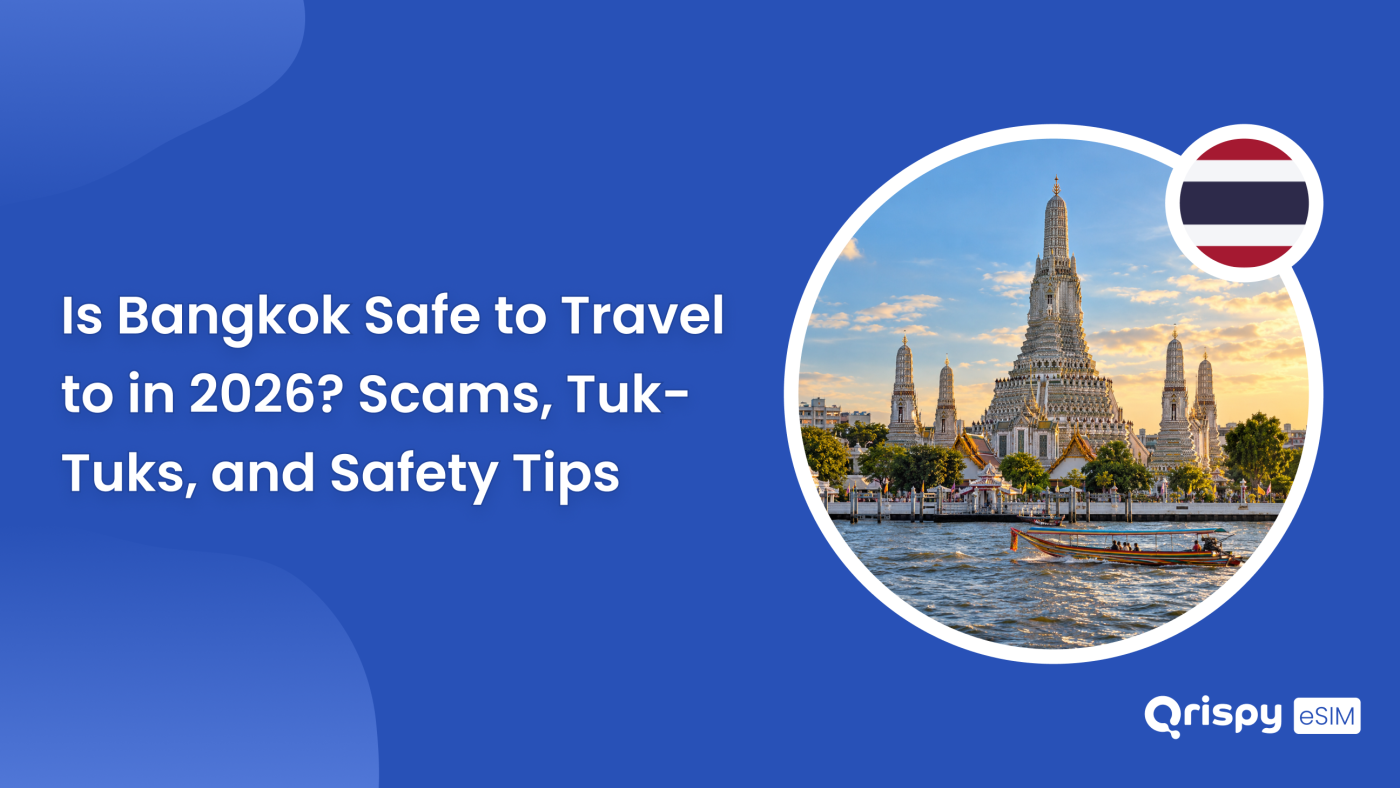
Yes, Bangkok is a safe city for visitors. Violent crime against tourists is rare, the country runs a dedicated tourist police unit with English-speaking officers, millions of people pass through every year without trouble. The risks that do exist are ordinary ones: traffic, heat, opportunistic theft in crowds, plus a set of well-worn approaches designed to separate visitors from their money.
None of that should keep you away. All of it is easier to handle once you know the shape of it, which is what this guide is for. Bangkok is chaotic in the way big Asian capitals are chaotic, not in a way that threatens you.
Below you will find where the real risks sit, how to handle tuk-tuks and taxis, what the districts are like, what to do about heat with street food, the laws worth respecting, the numbers to save in your phone, plus how a working data connection quietly makes all of it simpler.
Is Bangkok safe to travel in 2026?
Yes, with normal city precautions. Most governments place Thailand in the category that asks for ordinary caution rather than avoidance, with specific warnings attached to the far southern provinces near the Malaysian border. Those provinces sit hundreds of kilometres from Bangkok. Check your own foreign ministry before you book, since advisories change.
The honest ranking of risk in Bangkok puts roads first. Thailand’s road safety record is poor by international standards. Traffic is the most likely thing to hurt a visitor. Crime comes far down the list, with pickpocketing and bag snatching more common than anything confrontational. Political demonstrations happen from time to time. They are announced, localised and easy to avoid.
The risks that actually matter
Rank your caution by what is statistically likely rather than by what sounds dramatic.
- Traffic: crossing roads, riding pillion on a motorbike taxi without a helmet, hiring a scooter without the right licence.
- Heat: humidity plus temperature can flatten anyone who walks all afternoon without water.
- Opportunistic theft: phones left on bar tables, bags worn on the road side of a pavement, unattended luggage.
- Overcharging: agreeing to a service before agreeing what it costs.
- Alcohol: drinks left unattended, plus the long night that ends in a bill dispute.
- Air quality: fine particulate matter, known as PM2.5, spikes during the dry season.
- Weather: monsoon downpours flood streets fast between roughly May and October.
Common tourist tricks to know
None of the following is dangerous. All of them are annoying, all of them work on people in a hurry, all of them collapse the moment you decline politely then keep walking.
| The approach | How it works | What to do |
|---|---|---|
| The site is closed today | A friendly stranger near a temple says it is shut, then proposes an alternative tour | Walk to the official ticket gate and check for yourself |
| The cheap tuk-tuk tour | A very low fare that quietly includes stops at gem or tailor shops | Decline the tour, agree a fare for a direct trip only |
| Meter refusal | A taxi driver quotes a flat fare instead of switching the meter on | Ask for the meter, otherwise wave the next car down |
| The gift in your hand | A bracelet or bird seed is pressed on you, then payment is demanded | Keep your hands to yourself and say no thank you |
| Rental damage dispute | A scooter or jet ski is claimed to be damaged on return | Photograph it before you ride, never hand over your passport |
The gem shop version deserves its own warning, because it is the version that costs real money. Nobody in Bangkok can sell you stones that you will resell at a profit at home. Treat any conversation that arrives at that suggestion as entertainment, then leave.
Tuk-tuks, taxis and the Skytrain
Tuk-tuks are fun once. They are open to the traffic you are breathing, they have no seatbelts, they cost more than a metered taxi for the same trip. Agree the fare before you sit down, otherwise the negotiation happens when you arrive, which is a much weaker position.
Metered taxis are plentiful. Insist on the meter rather than a quoted price. Ride-hailing apps solve the problem entirely, since the route, the driver and the fare are recorded before you get in, which is also useful if you leave something on the seat.
Where possible, avoid the road. The Bangkok Mass Transit System (BTS) Skytrain runs above the traffic, the Metropolitan Rapid Transit (MRT) subway runs below it, both are air conditioned, cheap and simple to use. The Airport Rail Link connects Suvarnabhumi with the city, while Chao Phraya express boats turn a river crossing into the best commute in town. Last services run before midnight Indochina Time (ICT), so check the final departure if you are out late.
Districts and where to stay
Sukhumvit is the modern spine, strung along the Skytrain through Asok, Thonglor and Ekkamai, with the widest choice of hotels. Silom and Sathorn handle business by day plus nightlife after dark. Rattanakosin, the old royal quarter, puts the Grand Palace, Wat Pho and the river within walking distance, though it goes quiet early.
Khao San Road remains the backpacker heart, loud and cheerful. Yaowarat, the Chinatown district, is the best street food in the city after sunset. Ari suits slower mornings in cafes. Wherever you land, staying near a Skytrain or subway station is the single best decision you can make for both convenience and safety.
Heat, water and street food
Heat is the thing that catches visitors out. April is brutal, the rainy season runs roughly May to October. Cooler months from November to February are why so many people visit then. Carry water, plan indoor hours around midday, use the covered walkways that link Skytrain stations to malls.
Street food is generally safe, particularly at busy stalls where the turnover is fast and the cooking happens in front of you. Choose the queue rather than the empty counter. Drink bottled or filtered water rather than tap water. Ice from established vendors is factory produced, so it is not the hazard travellers assume. Pack rehydration salts, sunscreen and any medication you rely on, then buy anything else at a pharmacy chain rather than a market stall.
So is Bangkok safe to travel solo?
Yes. Solo travellers, including women, report Bangkok as one of the easier Asian capitals to navigate alone, helped by cheap transport, late opening food streets and plenty of company at hostels or coworking spaces. Ordinary precautions apply: tell someone where you are going, keep your phone charged, take a registered taxi or a ride-hailing car home rather than an unmarked vehicle.
Bangkok is also among the more relaxed cities in the region for LGBTQ+ travellers, with an open scene around Silom. Families do well here too, since malls are air conditioned refuges and Thai hospitality towards children is genuine. The universal rule is the same everywhere: watch your drink, watch your bag, avoid the argument that alcohol invents at 02:00 ICT.
Laws and etiquette to respect
Thailand has strict laws protecting the monarchy. They are enforced. Avoid any comment, image or gesture that could be read as disrespectful, online as well as in person. Drug offences carry severe penalties. Electronic cigarettes and vaping products are prohibited, which surprises visitors every year, so leave them at home.
Temples ask for covered shoulders with covered knees, shoes off at the door, feet pointed away from Buddha images. Do not touch anyone’s head. Women should not hand objects directly to a monk. A wai, the small bow with palms together, is returned rather than initiated by visitors. Carry a copy of your passport while the original stays in the hotel safe.
Emergency numbers to save now
Put these in your phone before you land, not while you need them.
- Tourist police: 1155, staffed by English speakers for visitor problems.
- Police: 191 for crime or immediate danger.
- Medical emergency: 1669 for an ambulance.
- Fire: 199.
Also save your embassy details, your insurance policy number plus the 24 hour assistance line for your travel cover. Check your government’s advice, such as the Foreign, Commonwealth and Development Office travel advice pages, alongside the Tourism Authority of Thailand for official guidance on the ground.
eSIM for Bangkok to stay connected
Connectivity is a safety tool here, not a luxury. A live map ends the closed temple conversation before it starts. A ride-hailing app records your driver with your route. Your phone reaches 1155 in seconds, shows your location to someone at home, translates a pharmacy label, holds your insurance documents. Landing without data is the single most common way visitors end up in a taxi they did not choose.
Public Wi-Fi covers malls, hotels and cafes, which is fine for a fixed base but useless on a street corner at night. A shared network is also a poor place to open your banking app. A local Subscriber Identity Module (SIM) card means a counter, a passport and a queue at the airport. Carrier roaming works instantly, usually at a clear premium over local rates. An embedded SIM (eSIM) avoids all 3 problems, because it is a profile you download to a compatible handset before you fly.
Qrispy is built around a single One eSIM that you install once and keep on the device, covering 210+ countries and regions. Data comes 3 ways on that same profile. The Global Wallet is pay as you go, with credits that never expire and rates that vary by destination, shown before you confirm. Fixed Plans are prepaid for 3, 7, 15 or 30 days. Unlimited Data Plans run in 90+ countries, subject to fair use or temporary speed management during very heavy usage. Because the profile stays on the device, a Bangkok trip that continues to Chiang Mai or across a border needs no new hardware.
Setup takes under 3 minutes. Choose a plan or top up the wallet, install the profile through the guided flow, then set Qrispy as your mobile data line with Data Roaming ON for it while your home SIM stays OFF. Keep the primary line active for calls plus one-time passcodes, because the Qrispy line carries data only. Unlimited personal hotspot is included on every plan, so a travelling pair or a family share 1 connection.
Because traffic exits at the nearest Qrispy Point of Presence (PoP), your IP address may appear to sit in another country or region. Coverage is unaffected, though geo-restricted streaming plus some login checks will notice. Confirm your handset on the eSIM device compatibility checker, then pick from the Qrispy eSIM plans for Thailand. Travel Buddy, the in-app assistant, adds local safety guidance, routes and phrase translation while you walk.
Frequently asked questions
Is Bangkok safe for solo women?
Yes. Solo women travellers generally find Bangkok straightforward, with cheap public transport, busy streets late into the evening and a large community of other travellers. Take the same precautions you would in any large city: a registered taxi or ride-hailing car at night, a charged phone, a drink you have watched being poured.
Are tuk-tuks safe to use?
Broadly yes, though they are the least safe road option in Bangkok. There are no seatbelts, you sit level with exhaust fumes, plus drivers can be aggressive in traffic. Agree the fare before you get in, refuse any tour that includes shop stops, then use metered taxis or the Skytrain for longer trips.
Is Bangkok street food safe?
Yes, for most visitors. Busy stalls turn over ingredients quickly and cook in front of you, which is exactly what you want. Pick the queue over the quiet counter, eat food that arrives hot, then skip anything that has been sitting out. Carry rehydration salts as a sensible precaution.
Can I drink the tap water?
No. Stick to bottled or filtered water, which is sold everywhere and is inexpensive. Ice served in restaurants, bars and established street stalls is factory produced, so it is generally fine. Use bottled water for brushing your teeth if you have a sensitive stomach, though many visitors do not bother.
What if something goes wrong?
Call the tourist police on 1155, which is staffed by English speakers for visitor problems. Dial 191 for anything urgent. For a medical emergency dial 1669. Report thefts in person so you have paperwork for your insurance, contact your embassy for lost passports, then keep digital copies of key documents.
Is Bangkok safe at night?
Yes, in the areas where people are. Sukhumvit, Silom, Yaowarat and the riverside stay busy well past midnight, with transport and food available throughout. Take a ride-hailing car rather than an unmarked vehicle, keep your phone out of your back pocket, then treat quiet unlit sois with the same caution you would at home.
Stay connected anywhere with Qrispy eSIM
Stay connected in 210+ countries with Global Wallet, Fixed Plans and Unlimited Data. No contracts, no roaming fees, no expiry. Download the Qrispy eSIM app today and start your journey.

Thailand Plans
Prepaid data plans for planned stays
Loading pricing plans...