


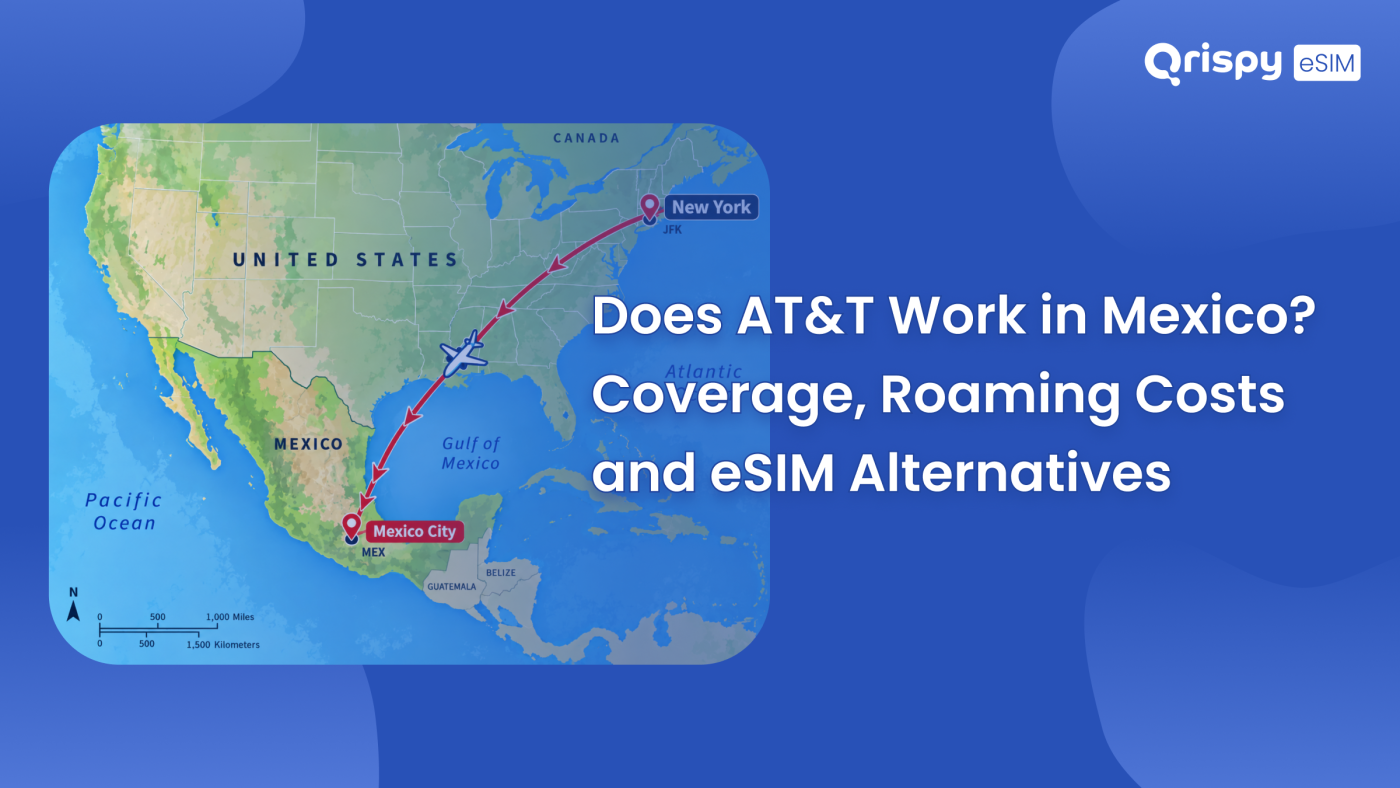
Yes, an AT&T phone works in Mexico. The handset registers on a partner network within minutes of landing. Whether that costs you anything extra depends almost entirely on which plan you are holding. AT&T has long bundled Mexico into the North America allowance on its higher unlimited tiers, while cheaper tiers, older grandfathered plans and prepaid lines usually push you towards a paid international add-on instead.
The real question is never whether service works. It is how much data you get at usable speed, what happens to your hotspot, how voice calls behave once you cross the border plus what the bill looks like if you guess wrong about your own plan.
Qrispy already publishes a walkthrough for getting an eSIM for Mexico, so this guide stays on the comparison itself. Below you will find how the roaming connection is actually built, where coverage thins out across the country, which parts of a plan quietly change at the border and how the alternatives compare when you are the one paying.
So does AT&T work in Mexico?
Yes. Service in Mexico is one of the more reliable roaming relationships available to a United States traveller, partly because AT&T operates its own network south of the border rather than relying purely on a third party. That gives the company an unusual amount of control over how customers are handled, which is why Mexico so often appears inside plan inclusions rather than only in the add-on menu.
What varies is the commercial treatment. Some plans include Mexico at full speed, some include it with a reduced-speed allowance after a threshold, some charge a daily fee that unlocks your home allowance for 24 hours and some bill per megabyte until you buy something. Check the AT&T website for the current rules attached to your specific plan, because these structures change more often than the coverage does.
How your phone reaches a Mexican network
Roaming is not a special mode inside your phone. Your Subscriber Identity Module (SIM) presents an identity that belongs to your home carrier, a local network recognises the country code inside it, then asks your carrier whether to accept the session. Approval takes seconds. Everything after that is billing.
Two details matter for travellers. First, the local network decides which technologies you get, so an older handset can drop to a slower service even where 5G is available to local customers. Second, your home carrier decides how your traffic is routed, which is why some roaming connections feel sluggish even with 4 or 5 bars showing. Long Term Evolution (LTE) coverage is widespread across Mexican cities, with 5G concentrated in larger metropolitan areas.
What decides your roaming cost
Carriers price international access with a small number of levers. Once you can see them, comparing any 2 options becomes straightforward.
- Whether the destination sits inside your plan or behind a paid add-on.
- Whether the add-on is charged per day, per month or per gigabyte (GB).
- How much high-speed data you get before speeds are reduced.
- Whether tethering is included, capped or excluded entirely while abroad.
- How calls and texts are treated, which is often separate from data.
- Whether a daily charge triggers on any usage, including a background app sync.
That last point catches more travellers than any other. A day pass that activates the moment a single email downloads can quietly bill for a travel day you spent asleep on a bus.
Coverage across Mexico is uneven
Mexico is a large country with dense mountain ranges, so the difference between a city and a canyon is dramatic. Mexico City, Guadalajara, Monterrey, Puebla, Queretaro and Merida offer the kind of coverage you would expect in a major metropolitan area. Resort corridors are similarly well served, including Cancun, Playa del Carmen, Tulum, Puerto Vallarta, Los Cabos and Mazatlan.
Away from those, the picture changes. The Sierra Madre ranges, the Copper Canyon region in Chihuahua, the Chiapas highlands, the interior of the Yucatan peninsula and long stretches of the Baja California peninsula all have gaps. Toll highways, known locally as cuotas, generally carry better coverage than the free roads that parallel them. Archaeological sites often sit far from towers, so download offline maps before you drive to one.
Coverage also varies by carrier inside Mexico. A roaming agreement ties you to specific partner networks, which means the traveller standing next to you on a different plan can genuinely have signal when you do not.
Check your plan before you fly
Do this while you still have home Wi-Fi, not in the airport queue. Open the myAT&T app or sign in on the website, find the international section for your line and read what your plan says about Mexico specifically rather than about international travel in general.
- Confirm whether Mexico is included in your plan or needs an add-on.
- Note any high-speed data threshold and what happens after you pass it.
- Check whether tethering is permitted while roaming on your tier.
- Look for a per-day trigger so you know what starts the charge.
- Take a screenshot of the terms as they appeared before departure.
- Set a data usage alert on the line so nothing runs silently.
Prepaid customers should look especially carefully. Prepaid and postpaid international rules differ on almost every United States carrier, so the assumption that they match is a common source of surprise charges.
Calls, texts and one-time passcodes
Voice deserves separate attention because banks do not care how you feel about roaming. Your bank sends a one-time passcode to your number. If that message cannot reach you, card verification stalls in a hotel lobby while you stand there arguing with an app.
Keep the home line reachable for text messages even if you plan to use another data source. Wi-Fi Calling lets you place and receive calls over an internet connection using your usual number, which sidesteps international voice charges entirely when it is enabled before you leave. Test it on home Wi-Fi first, since it usually has to be switched on while connected to your carrier’s network.
Where roaming bills usually go wrong
Nobody plans to spend a fortune on data abroad. The overspend almost always comes from the same handful of behaviours, all of them preventable.
- Automatic photo and video backup uploading a full day of 4K footage overnight.
- Streaming video at home quality on a hotel connection that has silently dropped to mobile data.
- Operating system updates downloading over cellular because Wi-Fi was flaky.
- A second traveller tethering off your phone without either of you tracking usage.
- Map applications re-downloading the same city because nothing was cached in advance.
- A day pass triggering on the day you fly home, purely from a background sync.
Switch backup to Wi-Fi only, download offline maps for every region you will visit and set your streaming apps to the lowest quality you can tolerate. Those 3 habits cut the majority of accidental usage on any plan.
eSIM alternatives to carrier roaming
An embedded SIM (eSIM) is a profile downloaded onto a chip already inside your phone, which means you can carry a Mexican or global data plan alongside your AT&T line without touching the physical tray. Your home number stays active for calls and passcodes while the data comes from somewhere cheaper.
Three realistic alternatives exist. A local Mexican prepaid SIM usually offers the strongest value for a long stay, at the cost of a shop visit, a passport check and a new number. A travel eSIM gives you data in minutes with no queue, no deposit and no local paperwork, so the Qrispy eSIM plans for Mexico can be installed the night before you fly. Public Wi-Fi covers the gaps for free, though hotel and airport networks are shared, unencrypted and a poor place to open a banking app.
Comparing your 4 connectivity options
Prices move constantly, so compare the shape of each option rather than a number you read months ago.
| Option | Best for | Watch out for |
|---|---|---|
| AT&T plan inclusion | Short trips on a tier that already covers Mexico | Reduced speed after a threshold, tethering limits |
| AT&T daily or monthly pass | Travellers who want one number and one bill | Charges that trigger on background activity |
| Local Mexican prepaid SIM | Stays of several weeks in one country | Shop queues, identity checks, a new number |
| Travel eSIM | Multi-country trips and fast setup | Data only, so keep the home line for calls |
Most travellers end up mixing 2 of these. Keeping the AT&T line live for calls and passcodes while a travel eSIM carries the data is the combination that solves the most problems at once.
How much data you actually need
Estimating usage badly is how people overpay in both directions. Messaging, email and maps are light. Social feeds, video calls and streaming are heavy, while shared hotspots multiply everything.
A week of maps, messaging, ride-hailing apps and moderate browsing sits comfortably in a small allowance for most people. Add daily video calls home or an evening of streaming and the figure climbs quickly. Qrispy’s eSIM data usage calculator turns your actual habits into a number, which beats guessing at a plan size and discovering the answer halfway through the trip.
Where Qrispy fits on a Mexico trip
Qrispy is built for exactly this decision. One eSIM installs once and stays on your device, covering 210+ countries and regions, so the same profile that carries you through Mexico also works on your next trip without a fresh purchase. Qrispy eSIM plans for your destination can be bought as a Fixed Plan for a set number of days or funded through the Global Wallet, where you top up a balance and the credits never expire.
Unlimited Data Plans are available in 90+ countries for 3, 7, 15 or 30 days, with no data cap, though fair use or temporary speed management can apply during very heavy usage or congestion. Unlimited personal hotspot is included on all plans, which matters if you travel with a laptop or a second device. Usage comes out of the same balance or allowance.
Set the Qrispy line as your data line with Data Roaming on, leave Data Roaming off for the AT&T line and keep that line active for calls and one-time passcodes. Because Smart IP Routing sends traffic through the nearest Qrispy Point of Presence (PoP), your connection may appear to originate outside Mexico, which does not affect coverage but can be noticed by a streaming service or a login check.
Frequently asked questions
Does Mexico cost extra on my plan?
Yes on some plans, no on others. Higher unlimited tiers have long treated Mexico as part of a North America allowance, while cheaper tiers, older plans and prepaid lines usually need a paid international add-on. Sign in to your account before travelling and read the terms attached to your own line rather than a general policy page.
Will my phone work in Mexico?
Almost certainly yes. Handsets sold in the United States within the last few years support the network bands used across Mexico, so the phone itself is rarely the problem. Older devices that relied on retired 3G networks are the main exception, since Mexican operators have moved traffic onto 4G and 5G.
Is a local Mexican SIM cheaper?
Yes, often, though the saving comes with trade-offs. You will queue at a shop, show identification and receive a Mexican number that your contacts do not have. For a stay of several weeks that is a fair exchange. For a long weekend the time cost usually outweighs the difference.
Do I need data roaming turned on?
It is required, yes, on whichever line you want to use abroad. A travel eSIM connects to a visiting network, so Data Roaming has to be enabled for that profile. Turn it off for your home line at the same time, which keeps the home number available for calls without letting it pull data.
Can I use my hotspot in Mexico?
Yes, provided your plan allows tethering while roaming. Some carrier tiers restrict or exclude it abroad even when it works at home, so check before you rely on it. Every Qrispy plan includes unlimited personal hotspot, with the usage deducted from the same balance or plan allowance.
What is the emergency number in Mexico?
911 is the national emergency number across Mexico, the same 3 digits used in the United States. Emergency calls travel over your voice line rather than a data-only travel eSIM, so keep your primary SIM in the phone and active. Save your accommodation address in Spanish for the call.
Stay connected anywhere with Qrispy eSIM
Stay connected in 210+ countries with Global Wallet, Fixed Plans and Unlimited Data. No contracts, no roaming fees, no expiry. Download the Qrispy eSIM app today and start your journey.

Mexico Plans
Prepaid data plans for planned stays
Loading pricing plans...