


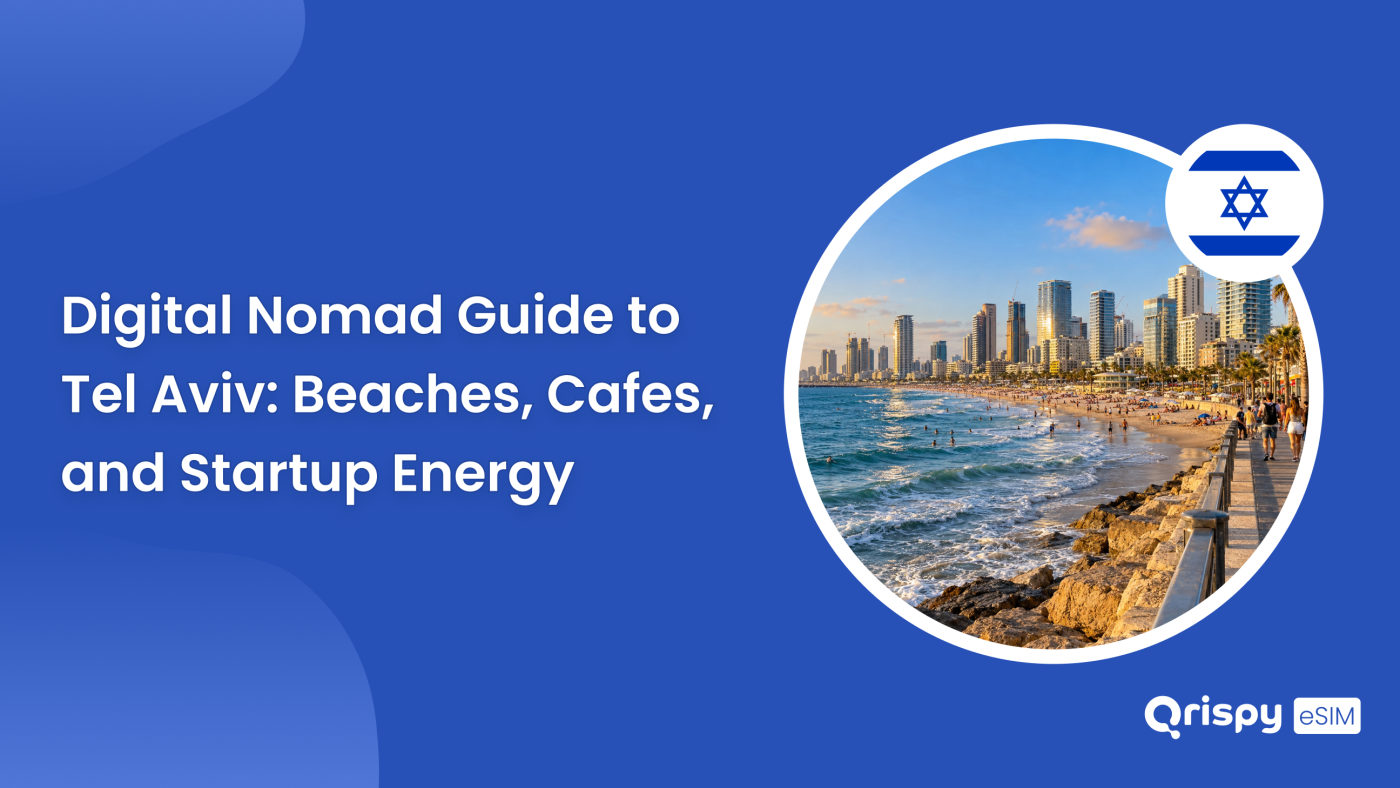
Tel Aviv is one of the easiest cities in the world to work remotely from and one of the hardest to do it cheaply. English is everywhere, the startup scene fills every second cafe, the beach is a 15 minute walk from most of the centre and the coworking supply is enormous for a city this size. The catch is cost. The second catch is that Israel has no dedicated nomad permit, so you are working on a tourist stamp.
Get those 2 things straight before you book and the rest is a pleasure: a compact, walkable, late-night city built on a grid of Bauhaus blocks between a park and the Mediterranean.
What follows covers entry rules, what a month costs, which neighbourhoods suit which stay, coworking and cafe culture, home and mobile internet, getting around, Shabbat and staying online.
A digital nomad guide to Tel Aviv
Start with the shape of the city. Almost everything a remote worker needs sits in a strip about 5 kilometres long between the Yarkon river and Jaffa.
| Area | Suits | Trade-off |
|---|---|---|
| Florentin | Younger budgets, bars, street art | Noisy, patchy building quality |
| Rothschild and Lev Ha’ir | Coworking, startups, walkability | The highest rents in the city |
| Old North | Quiet streets, cafes, Yarkon Park | Further from the nightlife |
| Neve Tzedek | Charm, short walk to the sea | Small stock, premium prices |
| Jaffa | Character, food, lower rents | Longer commute to Rothschild |
Nothing on that list is more than 30 minutes apart by bike, so choose on noise and budget.
Visa and entry mechanics
Israel does not run a digital nomad visa. Most Western passport holders enter on a B/2 visitor permit granted at the border, commonly for up to 90 days, which allows tourism but not employment with an Israeli company. Remote work for clients outside the country sits in the same grey zone as it does in much of Europe: not explicitly provided for, widely done and dependent on you not taking local work.
A pair of practical points matter. Visa-exempt travellers now need an electronic travel authorisation approved before departure, so apply well ahead rather than at the airport. Extensions beyond the initial stamp are handled by the immigration authority in person and are discretionary, not automatic. Check current rules for your nationality on the Israeli government portal before you book anything, because entry policy here changes more often than in most destinations.
Expect thorough questioning on arrival and departure. Have your accommodation booking, an onward ticket and a clear explanation of what you do ready.
Cost of living in Tel Aviv
Tel Aviv appears near the top of global cost of living rankings most years, mostly because of rent. A furnished 1 bedroom flat in the centre is the largest line in any nomad budget here, while short lets carry a premium over the 12 month contracts locals sign. Sharing a flat cuts that dramatically, which is why so many arrivals start in a room rather than a studio.
Beyond rent, watch for the local extras. Municipal property tax, known as arnona, is usually the tenant’s responsibility. Buildings charge a monthly maintenance fee. Agents take a commission on long lets. Deposits are substantial. Groceries cost noticeably more than in southern Europe, imported goods more again. Restaurant bills climb fast once you add a tip, which is expected and usually a little over a tenth of the total.
The savings are in the everyday. Market produce, hummus, falafel, sabich and bakery food are all inexpensive, tap water is drinkable, the beach is free and the bike lanes replace most transport spending.
Where to live in the city
Rothschild Boulevard and the streets around it put you inside the startup district, within walking distance of most coworking sites and the Bauhaus architecture that earned the White City its World Heritage listing. You pay for that convenience.
Florentin is the traditional landing spot for younger arrivals, full of workshops, murals, cheap food and late bars. It is loud. The Old North around Basel and Dizengoff is calmer, greener and closer to Yarkon Park. Neve Tzedek is the prettiest quarter and the most expensive per square metre. Jaffa gives you the flea market, the port and the best value in the city, at the cost of a longer ride north.
Flats are listed on local classified sites and in Facebook groups, most unfurnished by default. Sublets appear all summer when students leave, so a short stay is easier to arrange than a long one.
Coworking in Tel Aviv
Supply here is unusual. A city of this size supports dozens of coworking sites because the technology sector is so concentrated. Operators such as Mindspace and WeWork run multiple locations along the Rothschild corridor, around Sarona and near the railway stations. Formats are the usual ones: hot desks, dedicated desks and private offices, sold by the day, week or month.
Ask 3 things when you tour a space. Is there 24 hour access, because many buildings lock down in the evening. Are there enough phone booths, since open plan and back-to-back video calls do not mix. What happens on Friday afternoon and Saturday, when much of the city closes.
Cafe working is a genuine alternative. Tel Aviv has a deep cafe culture, laptops are normal on weekday mornings and power sockets are common. Weekend brunch is a different matter, when tables turn over fast and a laptop is unwelcome. Public libraries and the lobbies of the larger hotels fill the gaps.
Internet in Tel Aviv
Fixed connections are strong. Israeli homes are widely served by fibre, so a serviced flat or long let normally handles video calls and large uploads without drama. Ask the landlord which provider serves the building and whether the line is fibre rather than older copper, because the difference is noticeable on upload.
Public Wi-Fi is easy to find in cafes, malls and coworking lobbies. The municipality has also run a free network in public spaces including parts of the seafront. Treat all of it as convenient rather than private: shared networks are a poor place to log into a client system or a bank. A mobile connection you control is the safer default.
Getting around without a car
Do not hire one. Parking is scarce, expensive and enforced, while the city is flat and compact enough to cross by bike in half an hour. Bike lanes run along most main routes and shared electric bikes and scooters are everywhere, subject to helmet and age rules.
Buses cover the metropolitan area densely and use the Rav-Kav travel card. The Red Line of the light rail now links Petah Tikva to Bat Yam through the centre, with further lines under construction. Israel Railways runs north and south from Savidor Center, HaShalom and HaHagana. Ben Gurion Airport is about 20 kilometres out and the train from Terminal 3 reaches the centre in well under half an hour, which is the best way in unless you land during Shabbat.
Eating, Shabbat and weekends
Eat at the markets first. Shuk HaCarmel handles produce and street food, Levinsky Market is the spice and Balkan deli strip, the Jaffa flea market has become a dense restaurant quarter and Sarona Market is the tidy indoor version. The everyday canon is hummus with pita and pickles, falafel, sabich stuffed with aubergine and egg, shakshuka for a late breakfast, malabi for dessert and Yemenite jachnun on a weekend morning.
Shabbat runs from Friday sunset to Saturday nightfall and it reshapes your week. Buses and trains stop, many shops close and the working week here is Sunday to Thursday, so Sunday is a normal office day. Tel Aviv is the most secular city in the country, so plenty of restaurants, bars and beaches stay open, while shared taxis known as sherut keep running on the main routes. Plan calls for Sunday rather than Friday afternoon.
Safety and practical basics
- The currency is the Israeli new shekel, cards are accepted almost everywhere and cash is useful only in markets.
- Hebrew and Arabic are the local languages, although English is spoken widely and most signage is trilingual.
- Sockets are the Israeli Type H standard, so bring an adapter, although round 2 pin Type C plugs also fit.
- Emergency numbers are 100 for police, 101 for ambulance and 102 for fire.
- Tipping is expected in restaurants and cafes, often in cash and usually a little over a tenth of the bill.
- Petty theft is the main everyday risk, especially bikes, scooters and bags left on the sand.
- Check your government’s current travel advice before booking, because the regional situation can change quickly.
Residential buildings have protected rooms or shelters. The national Home Front Command publishes guidance and an alerting app. Ask your host where the shelter is when you arrive, as you would locate a fire exit. The municipality publishes local service information at the Tel Aviv Yafo city website.
eSIM for Tel Aviv to stay connected
Remote work makes mobile data a work tool, so compare the 4 options properly.
- Public Wi-Fi is fine for browsing and poor for anything sensitive.
- A local Subscriber Identity Module (SIM) card from an Israeli operator is cheap and effective, at the cost of a passport check, a queue and a swapped tray.
- Roaming on your home carrier needs no setup and usually costs the most, whether sold as a daily pass or charged per megabyte.
- A travel embedded SIM (eSIM) installs before you fly and works the moment you land.
Qrispy is built for that last case. Its One eSIM installs once, stays on the device and works across 210+ countries and regions, with 3 ways to buy data.
- Global Wallet is pay as you go, with credits that never expire and rates that vary by destination, shown before you confirm.
- Fixed Plans are prepaid for a country or region across 3, 7, 15 or 30 days.
- Unlimited Data Plans cover 90+ countries for 3, 7, 15 or 30 days, with fair use or temporary speed management possible during heavy congestion.
- Unlimited personal hotspot is included on every plan, which is the feature that matters most if you tether a laptop all day.
A couple of details are worth knowing before you rely on it for work. The Qrispy line carries data only, so keep your home SIM active for calls and one-time passcodes, then set Qrispy as the data line with Data Roaming on. Smart IP Routing sends traffic out through the nearest Qrispy Point of Presence (PoP), which lowers latency but can make your IP address look foreign, so expect the occasional extra login check.
Work out your monthly need with the Qrispy data usage calculator, since a tethered laptop and cloud backups consume far more than a holiday, then choose from the Qrispy eSIM plans for Israel. Travel Buddy is handy in the first week, suggesting neighbourhoods, routes and local etiquette.
Frequently asked questions
Does Israel have a digital nomad visa?
No. There is no dedicated remote work permit, so most visitors arrive on a B/2 tourist stamp granted at the border, commonly for up to 90 days. It allows tourism rather than local employment. Working online for foreign clients is common practice rather than a regulated category, so check current rules before you travel.
How expensive is Tel Aviv?
Expensive. The city sits near the top of global cost of living rankings and rent drives most of that, particularly for short furnished lets in the centre. Sharing a flat, living in Jaffa or Florentin and eating market food rather than restaurant meals changes the monthly total most.
Where should nomads stay in Tel Aviv?
Rothschild and Lev Ha’ir if you want to walk to coworking, Florentin if you want cheap and lively, the Old North for quiet mornings beside Yarkon Park and Jaffa for character and better value. Everything is within a 30 minute cycle, so pick on noise and budget rather than distance.
Is the internet fast in Tel Aviv?
Yes. Fibre is widely available in flats, coworking spaces are built around reliable connections and cafe Wi-Fi is common. Ask a landlord whether the building is on fibre before signing, because upload speed matters for video calls. Keep a mobile connection as backup for anything sensitive.
What happens on Shabbat?
Public transport stops from Friday sunset until Saturday nightfall, many shops shut and the working week runs Sunday to Thursday. Tel Aviv stays livelier than elsewhere in the country, with beaches, bars and many restaurants open, while shared sherut taxis continue on the main routes.
Does an eSIM work in Israel?
Yes, provided your handset is unlocked and eSIM compatible. Install the profile over Wi-Fi before departure and it connects to a local network on arrival. Keep your home SIM active for calls and one-time passcodes, then set the eSIM as your data line with Data Roaming on.
Stay connected anywhere with Qrispy eSIM
Stay connected in 210+ countries with Global Wallet, Fixed Plans and Unlimited Data. No contracts, no roaming fees, no expiry. Download the Qrispy eSIM app today and start your journey.

Israel Plans
Prepaid data plans for planned stays
Loading pricing plans...