


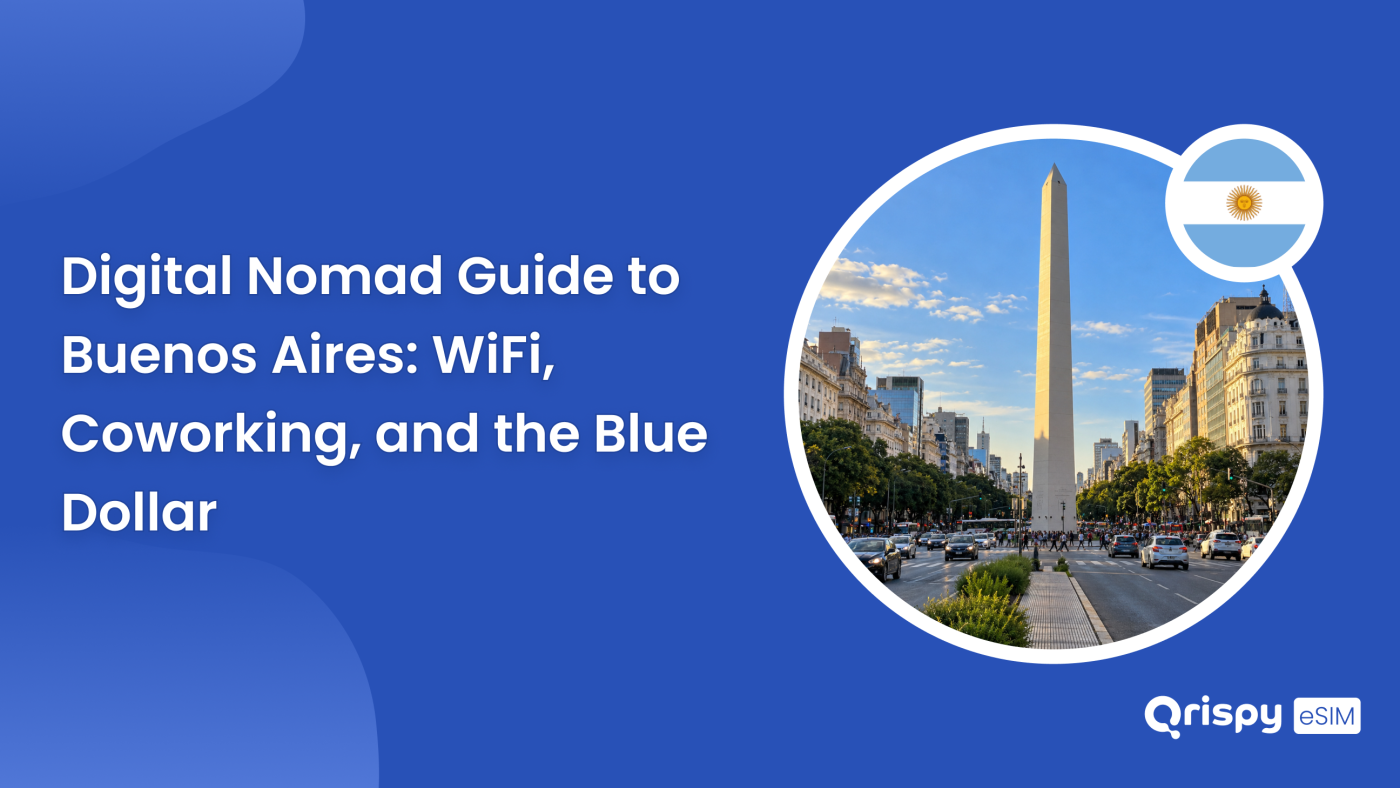
Buenos Aires works for remote workers. The reasons are practical rather than romantic. The city sits at Coordinated Universal Time (UTC) minus 3 with no seasonal clock change, which puts you 1 or 2 hours ahead of the east coast of the United States and a manageable few hours behind most of Europe. Add constant coffee, a cafe culture that tolerates a laptop plus a coworking scene concentrated in a handful of walkable barrios. The working day then arranges itself.
The friction is money. Argentina has spent years managing currency controls that opened a gap between the official exchange rate and a parallel market rate. Those rules have moved repeatedly. Anything you read about pesos needs checking against a current official source before you act on it.
What follows covers where to live, where to work, how home internet behaves, how the blue dollar functions, what living here costs, the visa mechanics for staying longer and how to keep a connection when the power drops.
Digital nomad guide to Buenos Aires
Start with the rhythm, because it governs everything else. Argentines eat late. Dinner rarely starts before 21:00 Argentina Time (ART), which means evenings stretch well past midnight and mornings begin gently. If your calls land in the European morning you will be up early against the city’s grain. If your team sits in North America, the overlap is almost perfect.
The city itself is dense, flat and built for walking, with tree-lined avenues, endless bookshops and a habit of putting a cafe on every corner. Spanish is essential for daily life beyond the tourist core, though the Rioplatense accent takes a fortnight to tune into. Expect warm humid summers from December to February and mild damp winters from June to August.
Where to base yourself
- Palermo Soho and Palermo Hollywood hold the densest cluster of cafes, coworking desks and short-term flats.
- Villa Crespo sits next door, costs less and keeps the same transport links.
- Recoleta offers grand architecture, quiet streets and an older residential feel.
- San Telmo suits people who want cobbles, antiques markets and tango over comfort.
- Colegiales and Chacarita are calmer, greener and increasingly popular with long stayers.
- Belgrano and Núñez feel residential and well connected, with good supermarkets and parks.
Coworking in Buenos Aires
Coworking here splits into 3 tiers. Established operators such as La Maquinita Co, AreaTres, Urban Station and WeWork run multiple sites across Palermo, Belgrano and the microcentro, selling day passes alongside monthly desks. Smaller independent spaces occupy converted houses in Villa Crespo and Chacarita, usually quieter and more social. Then there is the cafe layer, which in this city is a legitimate option rather than a compromise.
Before you commit to a monthly desk, visit at the hour you actually work. Check whether the space has backup power, because summer heatwaves trigger outages that take the building network down with them. Ask about air conditioning, bookable meeting rooms and whether the wireless network is shared with a busy cafe downstairs. Test the upload speed rather than the download figure, since video calls fail on upload first.
Internet in Buenos Aires
Fixed line internet in the central barrios is genuinely good. Fibre has reached much of Palermo, Belgrano, Recoleta and Villa Crespo, delivered by providers including Telecentro, Flow, Movistar and Personal, while older buildings still run on cable or copper that behaves very differently. When you view a flat, ask which provider serves it and whether the connection is fibre.
Power is the weak point. Heat drives demand every summer. Neighbourhood outages of several hours are a recurring feature rather than a rare event. A router without a battery backup dies with the lights, which is why experienced remote workers here keep a charged phone and a mobile data plan as the fallback for a call they cannot move. Buildings with a generator advertise the fact, so it is worth asking.
The blue dollar explained
The phrase refers to the parallel exchange rate for United States dollars that emerged while Argentina restricted access to foreign currency. When residents cannot freely buy dollars at the official rate, an informal market prices them differently. The gap between the 2 rates became a defining feature of daily economics. Prices, salaries and rents all quietly adjust around it.
For a visitor the practical questions are simple: how your card settles when you pay in a shop, what rate applies when you withdraw cash and whether a legitimate remittance route converts at something closer to the parallel rate. International money transfer services have historically been the mainstream answer for exactly that reason. Informal exchange counters, including the callers advertising cambio along Calle Florida, sit outside the formal banking system, offer no consumer protection and carry a real risk of counterfeit notes or sleight of hand while counting.
None of this is stable. Controls have been loosened, tightened and restructured repeatedly. A rule that held last season may have gone. Treat any specific rate or mechanism you read as a starting point, then confirm it against the official government portal at Argentina.gob.ar or with your own bank before you move money.
Cost of living in Buenos Aires
Relative to other capitals, Buenos Aires is affordable for someone earning in a hard currency. That is the honest summary. Furnished short-term flats aimed at foreigners are usually advertised in United States dollars, while longer local leases run in pesos and normally require a guarantor, which puts them out of reach for most visitors.
Eating out, domestic wine, taxis and public transport all feel inexpensive by European or North American standards. Imported electronics and anything shipped from abroad feel expensive, so bring the laptop you need rather than planning to buy here. Inflation revalues everything on a short cycle, so a budget you built from a blog post written last year will be wrong. Price a week in the city yourself once you arrive, then extrapolate.
Visa mechanics for remote workers
Many nationalities enter Argentina as tourists without applying for a visa in advance, with a stay measured in days that is commonly extended once through the national migration office. Argentina also created a transitory residence category for remote workers, aimed at people employed or contracted by companies outside the country, which sits between a tourist stamp and full residency.
Border hops to Colonia del Sacramento or Montevideo by ferry are a well-worn habit among long stayers, though re-entry remains at the discretion of the officer on the desk and repeated short exits attract questions. Residency routes also exist for citizens of neighbouring South American countries.
Requirements, permitted durations and paperwork change with policy, so read the current rules on the official migration pages of the Argentine government rather than a forum thread. Bring proof of onward travel, accommodation and income if you plan a long stay, because those are what get asked for.
Getting around and eating well
The Subte underground runs 6 lines lettered A to E plus H. It is the fastest way across the centre in rush hour. Buses, known universally as colectivos, cover everything the Subte misses and run through the night. Both need a Sistema Único de Boleto Electrónico (SUBE) card, sold at kiosks and stations and topped up at the same places. Ecobici bikes suit the flat grid. Suburban rail lines reach the northern suburbs and the delta at Tigre. Transport details are published by the city at buenosaires.gob.ar.
Food is a serious part of the compensation. Work through asado at a parrilla, milanesa napolitana in a bodegón, empanadas by the dozen, fugazzeta pizza thick with onion and cheese, medialunas with coffee and dulce de leche in everything sweet. Malbec is the default red, Fernet with cola the default long drink and a Sunday afternoon at the San Telmo feria the default way to lose 4 hours.
eSIM for Buenos Aires to stay connected
Mobile coverage is strong, with 4G everywhere and 5G in central areas, so the mobile network is the sensible backup when the building loses power. Your options divide neatly.
| Option | How it works here | Best suited to |
|---|---|---|
| Public Wi-Fi | Free in many cafes, parks and Subte stations, on open shared networks. | Casual browsing between meetings. |
| Local prepaid SIM | Sold in shops with registration, giving an Argentine number for local services. | Stays of several months. |
| Carrier roaming | Your home plan extended abroad on a daily pass or capped allowance. | A short scouting visit. |
| Travel eSIM | Installed before arrival, active on landing, topped up from the app. | Remote workers who cannot lose a call. |
Open networks in cafes are convenient but shared, so route client work and banking over mobile data instead. A local Subscriber Identity Module (SIM) card makes sense if you need an Argentine number for delivery apps or bank verification, at the cost of registration paperwork. Roaming is the least effort and usually the most expensive, since carriers structure international access as a daily charge or a bundled allowance that a working day burns through quickly.
A travel embedded SIM (eSIM) is the natural fit for someone who works from a laptop. Qrispy runs on a single One eSIM that you install once and keep on the device, covering 210+ countries and regions, so the same profile follows you from Buenos Aires to Montevideo without a new purchase. Global Wallet works as pay as you go with credits that never expire, which suits an open-ended stay. Fixed Plans cover 3, 7, 15 or 30 days with a set allowance. Unlimited Data Plans reach 90+ countries, with fair use or temporary speed management possible during heavy congestion.
Unlimited personal hotspot is included on every plan, which is the feature that matters during an outage: tether the laptop to the phone and the call continues. Keep your home SIM active for calls and bank codes, then set Qrispy as the data line with Data Roaming on for Qrispy only. Because the Qrispy line carries data rather than a number, voice runs over Wi-Fi Calling or apps such as WhatsApp. Smart IP Routing exits traffic at the nearest Qrispy Point of Presence (PoP), which for Argentina is Sao Paulo, cutting latency while sometimes confusing a streaming service about your location. Work out how much data your call schedule needs with the Qrispy data usage calculator, then choose from the Qrispy eSIM plans for Argentina. Travel Buddy in the app suggests neighbourhoods, routes and phrases while you settle in.
Frequently asked questions
Is Buenos Aires good for nomads?
Yes. The time zone overlaps well with the Americas and workably with Europe. Cafe and coworking culture is mature, while living costs stay low for anyone earning in a hard currency. The trade-offs are currency complexity, summer power cuts and the need for functional Spanish once you leave the tourist core.
What is the blue dollar?
It is the informal parallel exchange rate for United States dollars that developed while Argentina restricted access to foreign currency. The gap between that rate and the official rate shaped prices, rents and salaries for years. Rules change frequently, so confirm how your card or transfer settles against an official source before relying on any figure.
How fast is internet in Buenos Aires?
Fibre reaches much of Palermo, Belgrano, Recoleta and Villa Crespo and handles video calls comfortably, while older buildings on cable or copper perform noticeably worse. Ask any landlord which provider serves the flat and whether the line is fibre. Test upload speed rather than download, because calls degrade on upload first.
Do you need a nomad visa?
Not necessarily. Many nationalities enter as tourists without a prior visa and can request an extension through the migration office, which covers a lot of shorter stays. Argentina also has a transitory residence category for remote workers employed abroad. Rules shift, so check the official migration pages before you plan a long stay.
Is Buenos Aires expensive to live in?
No, not for someone paid in dollars, euros or pounds. Eating out, transport, domestic wine and services feel inexpensive, while imported electronics are costly and furnished flats aimed at foreigners are priced in dollars. Inflation moves quickly, so build your budget from prices you see yourself rather than from an older guide.
Which neighbourhood suits remote workers best?
Palermo remains the default for its cafes, coworking spaces and short-term flats, with Villa Crespo offering the same access for less. Choose Recoleta for quiet grandeur or Colegiales and Chacarita for a calmer residential feel. San Telmo suits you if atmosphere matters more than a reliable lift and modern wiring.
Stay connected anywhere with Qrispy eSIM
Stay connected in 210+ countries with Global Wallet, Fixed Plans and Unlimited Data. No contracts, no roaming fees, no expiry. Download the Qrispy eSIM app today and start your journey.

Argentina Plans
Prepaid data plans for planned stays
Loading pricing plans...