


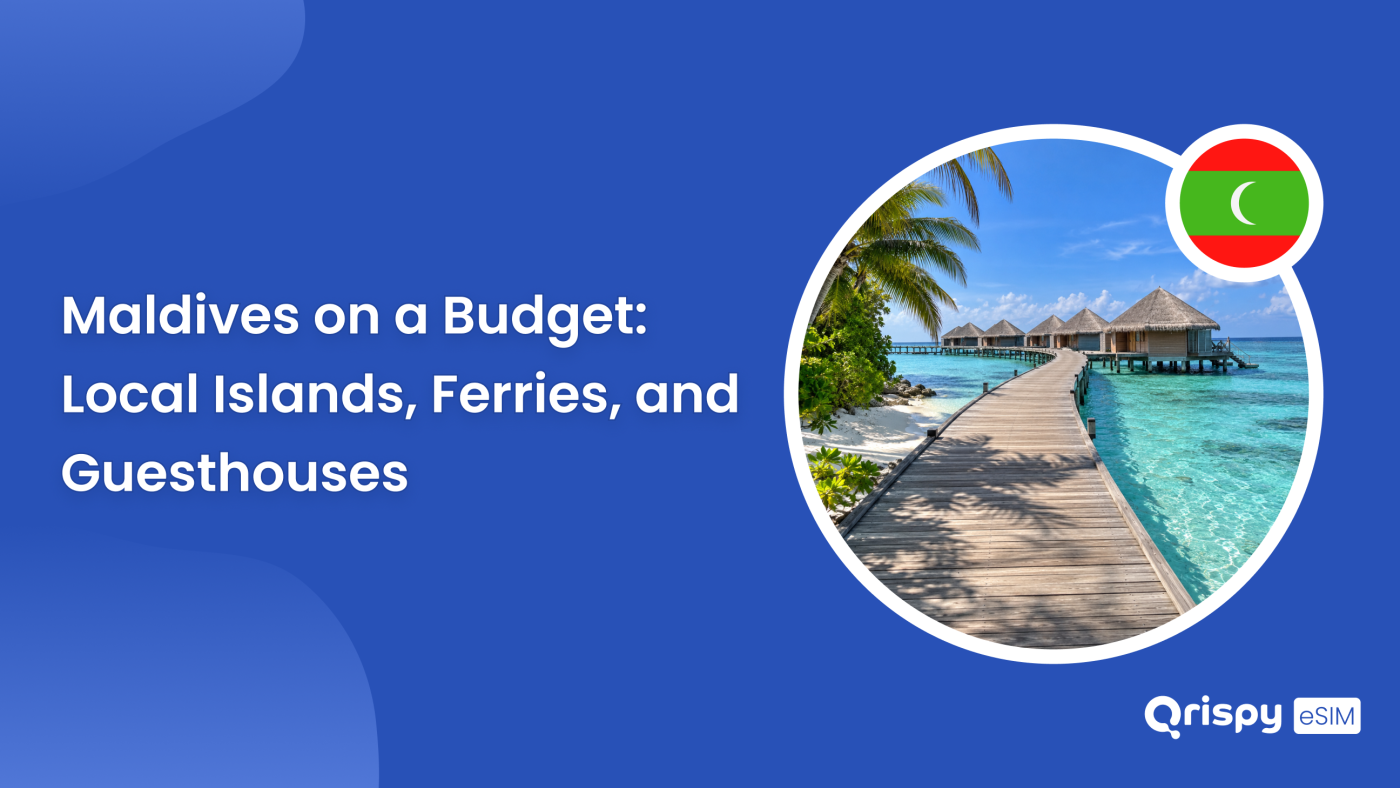
Yes, you can visit the Maldives on a modest budget. The mechanism is simple: stay in a guesthouse on an inhabited local island instead of a resort, then move around on the public ferry network instead of by seaplane. Since guesthouses were legalised on local islands, the country has had a genuine independent travel scene running alongside the resorts. Almost nobody landing at the airport for the first time knows it exists.
This guide covers Malé on a budget along with the local island system that surrounds it. It is written for independent travellers in 2026 who want reef, sandbanks and Maldivian food without a private island price tag. Expect to trade a little comfort for a lot of saving.
Below: how the local island system works, when to go, getting in from the airport, how ferries run, choosing an island, guesthouse etiquette and how to stay online.
Malé on a budget
Malé ranks among the most densely populated cities on earth, packed onto an island you can walk across in under half an hour. It is not a beach destination, so treat it as a transit hub with a few interesting hours in it rather than a place to linger.
Most budget travellers now base themselves in Hulhumalé, the reclaimed island beside Velana International Airport, joined to Malé by the Sinamalé Bridge. Rooms cost less than in the capital, there is a long public beach on the eastern shore and buses run over the bridge into the city. If your flight lands late or leaves early, Hulhumalé saves you money and a ferry crossing.
- Currency is the Maldivian rufiyaa (MVR), though United States dollars are accepted almost everywhere.
- Dhivehi is the national language. English is widely spoken in tourism and government.
- Sockets are types D and G on a 230 volt supply, so a British-style adapter usually works.
- Emergency numbers are 119 for police, 102 for ambulance and 118 for fire and rescue.
- Alcohol is not sold on inhabited islands, including Malé and Hulhumalé.
How local islands changed the Maldives
For decades the rule was strict: tourists stayed on uninhabited resort islands, Maldivians lived on the others. That changed when guesthouses were permitted on inhabited islands. Small family-run properties spread across the atolls. You now sleep in a village with a mosque, a school and a football pitch, eat where the islanders eat and pay a fraction of the resort rate.
The trade-offs are real. Local islands follow Islamic law, so alcohol is unavailable and swimwear is restricted to designated bikini beaches. Rooms are simple. Boats to the reef cost extra. In exchange you get the same water, the same manta rays and far more contact with the country you flew to see.
When to visit and what it costs
The Maldives has 2 seasons driven by monsoon winds. The north-east monsoon, roughly January to March, brings the calmest seas, the clearest visibility and the highest prices. The south-west monsoon, roughly May to November, is wetter and windier, with squalls that pass quickly. Guesthouse rates soften noticeably in those months.
Wet season has a genuine upside. Plankton blooms draw manta rays and whale sharks, so Hanifaru Bay in the Baa Atoll biosphere reserve and the reefs off South Ari Atoll are at their best. Expect to pay separately for boat trips, snorkelling gear and any excursion beyond the house reef. Budget for those extras rather than the bed alone.
Getting in from Velana airport
Velana International Airport sits on its own island, Hulhulé, next to Malé. From arrivals you have 3 sensible options. A public ferry crosses to Malé harbour regularly for very little. Public buses run over the Sinamalé Bridge to Malé and Hulhumalé. Private speedboat and taxi transfers are quicker and much dearer.
Plan your arrival around the ferry you need next. Atoll ferries leave Malé usually in the afternoon. Many routes skip Fridays entirely. Land late and you will almost certainly spend a night in Hulhumalé before travelling on. Check jetties carefully, because Villingili, atoll and airport ferries all depart from different points.
Public ferries and speedboat transfers
The public ferry network is the backbone of budget travel here. Slow diesel ferries link Malé with the inhabited islands of the nearer atolls, running to a published timetable at a fraction of any private fare. They are basic, open-sided and often full of islanders carrying shopping. Journeys of 2 to 4 hours are normal.
- Timetables change with the season, so confirm departures locally the day before you travel.
- Many routes pause on Fridays for prayers, which can strand an unplanned traveller for a day.
- Shared speedboats cost more than ferries but far less than private transfers.
- Seaplanes serve resorts rather than local islands. They are also the most expensive option available.
- Build a buffer day before an international flight, because rough weather cancels boats.
Choosing your local island
Maafushi in Kaafu Atoll is the best known guesthouse island, close to Malé and busy with dive shops, excursions and a designated bikini beach. Gulhi and Guraidhoo sit nearby and stay quieter. Thulusdhoo attracts surfers to the breaks off its reef, while Dhiffushi and Huraa suit travellers wanting a village rather than a scene.
Further out the water gets better. Ukulhas and Rasdhoo in Alif Alif Atoll have strong reefs and a reputation for cleanliness. Dhigurah in South Ari Atoll is the base for whale shark snorkelling, with a long sandbank you can walk for kilometres. Dharavandhoo in Baa Atoll is the gateway to Hanifaru Bay when the mantas arrive.
Guesthouse life and island etiquette
Guesthouses are family businesses on residential streets, so behave as a guest in a village. Most include breakfast. Many offer half board because restaurant choice is limited. Staff also organise snorkelling trips, sandbank picnics and transfers.
- Cover shoulders and knees away from the designated bikini beach, for men as well as women.
- Wear swimwear only on the bikini beach or on an excursion boat.
- Do not bring alcohol into the country, since customs checks luggage at arrival.
- Ask before photographing people, particularly women and children.
- Public displays of affection are best avoided on inhabited islands.
- During Ramadan, eat and drink discreetly and out of sight during daylight hours.
Free and cheap things in Malé
The capital rewards a walk. Start at Hukuru Miskiy, the old Friday Mosque built from carved coral stone in the 17th century, then look at the gold dome of the Islamic Centre nearby. Republic Square, the tsunami monument and the presidential residence at Mulee-aage all sit within a short stroll.
Head north to the waterfront for the fish market and the produce market, both free to wander and the most interesting places in the city. Watch tuna being cut on the harbour front. Rasfannu beach on the western side is a public swimming spot where locals gather at sunset. The National Museum in Sultan Park charges entry. For a change of pace, take the public ferry to Villingili, a car-free island with a beach and no traffic. Majeedhee Magu is the main shopping street, while Chaandhanee Magu is where souvenirs cluster.
Eating well for less
Local cafes, known as hotaa, are where the savings live. Breakfast is mas huni, shredded smoked tuna mixed with coconut, onion and chilli, eaten with roshi flatbread. Lunch is often garudhiya, a clear fish broth poured over rice with lime and chilli.
Short eats, called hedhikaa, are the national snack: gulha, bajiya, masroshi and keemia, sold from trays in the afternoon and priced for locals. Grilled reef fish appears everywhere. For pudding, look for saagu bondibai, a sweet sago dish. Maldivian black tea is served strong and sweet. Sticking to hotaa food rather than tourist menus is the biggest saving available after your accommodation choice.
Safety and common pitfalls
The Maldives is a safe destination with low crime. The genuine risks are practical. Currents between islands and along reef edges run strong, so snorkel with a buddy, wear a rash vest against the sun and treat channel swims with respect. Coral cuts infect quickly in warm water.
The most common budget mistake is underestimating transfers. Travellers book a cheap island then discover the only same-day connection is a private speedboat costing more than several nights of accommodation. Plan movements around the ferry schedule. Other pitfalls are smaller: sun exposure on open boats, thin pharmacy stock and cash-only guesthouses in remote atolls. Official entry rules are published by Maldives Immigration, and destination guidance sits on Visit Maldives.
eSIM for Malé to stay connected
Coverage across the inhabited islands is better than most visitors expect, because Maldivian networks serve a population spread across hundreds of islands. Malé and Hulhumalé are well covered. Signal holds on the main ferry routes then drops on open water between atolls. Guesthouse Wi-Fi is normal but shared. It slows every evening when the whole island comes online.
| Option | Best for | Watch out for |
|---|---|---|
| Guesthouse Wi-Fi | Evening messaging and photo uploads | Shared bandwidth, slow at night, open networks |
| Local SIM card | Stays of several weeks | Passport registration and airport counter queues |
| Carrier roaming | Doing nothing before you fly | Usually the most expensive of the 4 |
| Travel eSIM | Landing already connected | Needs an unlocked, compatible handset |
A local Subscriber Identity Module (SIM) card is inexpensive and easy to buy at the airport, though it means passport registration and a number nobody has. Carrier roaming needs no preparation and usually costs the most, sold as a daily pass or a bundled inclusion worth pricing first.
An embedded SIM (eSIM) is the neat answer for a short trip. Qrispy runs on One eSIM that installs once and stays on your device, covering 210+ countries and regions. Top up the Global Wallet and pay as you go with credits that never expire, at rates shown before you confirm. Fixed Plans run for 3, 7, 15 or 30 days, while Unlimited Data Plans cover 90+ countries for 3, 7, 15 or 30 days, with fair use or temporary speed management during very heavy usage. Unlimited hotspot is included, useful when guesthouse Wi-Fi gives up. Browse Qrispy eSIM plans for the Maldives and size your allowance with the Qrispy data usage calculator.
2 details matter here. The Qrispy line carries data only, so calls and texts go over Wi-Fi Calling on your home number or through apps such as WhatsApp. Smart IP Routing sends traffic out through the nearest Qrispy Point of Presence (PoP), with Singapore the closest live location, which lowers latency but can make streaming services think you are elsewhere. Travel Buddy in the app suggests island hops and translates phrases.
Frequently asked questions
Can you visit the Maldives cheaply?
Yes. Stay in a guesthouse on an inhabited local island rather than a resort, travel on the public ferry network instead of by seaplane and eat in local cafes. That combination brings the Maldives into the range of ordinary independent travel. Excursions, snorkelling trips and private speedboat transfers are where budgets quietly break.
Are public ferries reliable enough?
They are reliable but slow and infrequent. Routes run to a published timetable, often only a few times a week. Many pause on Fridays for prayers. Weather cancels sailings occasionally. Build a buffer day before any international flight and confirm the next departure with your guesthouse rather than trusting an old schedule.
Can you drink alcohol on local islands?
No. Alcohol is not sold on inhabited islands, including Malé and Hulhumalé, and importing it is prohibited. Customs checks luggage on arrival. If you want a drink, the options are a resort island, a liveaboard vessel or a licensed hotel near the airport. Plan around it rather than trying to work around it.
What should you wear on local islands?
Cover shoulders and knees anywhere in a village, for men as well as women. Swimwear belongs on the designated bikini beach or on an excursion boat. A light long-sleeved shirt and loose trousers handle both the sun and the etiquette. In Malé, dress the way you would in any conservative capital city.
Is Malé worth a night?
A few hours, yes. A whole night, only if your flights demand it. Walk the coral stone Friday Mosque, the fish market and the waterfront, then take the ferry to Villingili if you have time. Most budget travellers sleep in Hulhumalé instead, where rooms cost less and the airport is minutes away.
Does mobile data work between islands?
Mostly. Maldivian networks cover the inhabited islands well. Signal usually holds along the busier ferry routes. It fades on open water between atolls and around remote reefs. Download offline maps and ferry timetables before you sail. A travel eSIM with multi-network switching helps your phone latch onto whichever network reaches furthest.
Stay connected anywhere with Qrispy eSIM
Stay connected in 210+ countries with Global Wallet, Fixed Plans and Unlimited Data. No contracts, no roaming fees, no expiry. Download the Qrispy eSIM app today and start your journey.

Maldives Plans
Prepaid data plans for planned stays
Loading pricing plans...