


Yes, Delhi is safe to travel to for most visitors in 2026, as long as you treat it like a large, dense capital rather than a theme park. Millions of people arrive every year without incident. The realistic risks are petty theft, transport hassle, well-worn tourist traps, seasonal air pollution and, for women travelling alone, unwanted attention that ranges from staring to verbal harassment. Serious violent crime against foreign visitors is rare.
No honest guide pretends the city is effortless. Delhi rewards preparation more than almost any capital in Asia. Knowing where to base yourself, how to move around after dark, when the air turns bad and how the standard approaches at stations work removes most of what actually goes wrong for travellers.
This guide sets out what government travel advisories say, the crime picture, safety for women travellers, transport, air quality, food and water, then the habits that keep a trip smooth. It ends with staying connected, which in Delhi is a safety tool rather than a convenience.
Is Delhi safe to travel?
Yes, with the caveats above. Delhi is not dangerous in the way sensational headlines suggest, but it is demanding: crowded, noisy, hot for much of the year and full of people whose living depends on persuading you to go somewhere. The useful question is which specific risks apply to you. The table sets out the honest picture.
| Risk | How likely | What to do |
|---|---|---|
| Pickpocketing | Common in crowds | Cross-body bag, nothing in back pockets, phone away outdoors. |
| Overcharging | Very common | Book rides in an app or agree the fare first. |
| Air pollution | Severe in winter | Check the index daily, wear a fitted mask. |
| Stomach upset | Common | Bottled or filtered water, busy stalls, no pre-cut fruit. |
| Violent crime | Rare for tourists | Normal night precautions, licensed transport after dark. |
| Harassment of women | Reported regularly | Women-only metro carriage, pre-booked cars, avoid empty streets late. |
What travel advisories actually say
Most Western governments advise normal precautions for Delhi itself while flagging specific regions of India for stricter warnings. The UK Foreign, Commonwealth and Development Office (FCDO), the United States Department of State and Australia’s Smartraveller all publish country pages that are updated when conditions change. Read your own government’s page rather than a summary, because insurance policies are frequently written to follow that advice.
Advisories tend to concentrate on 4 themes for the capital: petty crime in crowded areas, the risk of sexual assault against women, road traffic accidents and periodic demonstrations. They also flag air pollution as a health issue in winter. Check official travel advice shortly before you fly rather than months ahead, since wording changes with events on the ground.
Crime in Delhi and real risks
Crime against tourists in Delhi skews heavily towards opportunism rather than violence. Pickpocketing happens in crowded markets, on packed metro carriages and around the New Delhi and Old Delhi railway stations. Bag snatching from open auto-rickshaws occurs at traffic lights. Hotel room theft is uncommon in registered properties but worth guarding against.
The pattern to internalise is that trouble usually starts with an unsolicited conversation. Someone tells you the road ahead is closed, your hotel has burned down, the tourist office has moved or the monument shut early. Each of those openers exists to redirect you towards a shop or an agency that pays commission. Politely keep walking. Nothing genuine in Delhi requires a stranger to intercept you on the pavement. If something does go wrong, the tourist police posted at major monuments and stations are the right first stop.
Safety for women travellers
Delhi requires more care from women than most capitals. Pretending otherwise helps nobody. Staring is constant rather than threatening. Verbal harassment happens. Groping in dense crowds is reported often enough that residents plan around it, which is precisely why the first carriage of each Delhi Metro train is reserved for women.
Practical habits carry most of the load. Dress on the conservative side in Old Delhi, at religious sites and in residential areas, keeping shoulders and knees covered. Use pre-booked cars at night rather than flagging anything on the street. Share your live location with someone. Choose accommodation in Aerocity, South Delhi or a well-reviewed guesthouse rather than the cheapest room near a station. Many women travel Delhi solo very happily, which is worth saying plainly.
Common tourist traps in Delhi
Delhi runs a small number of very persistent routines aimed at new arrivals, most of them clustered around Connaught Place, Paharganj and the railway stations. None involve violence. All involve separating you from money through misdirection rather than force.
- Fake tourist offices near New Delhi station that sell overpriced tours.
- Drivers who insist your hotel is closed and offer an alternative.
- Auto-rickshaw drivers who name a tourist price instead of the fare.
- Gem or carpet export offers dressed up as a favour.
- Someone flicking something onto your shoe, then offering to clean it.
Your counter is dull and effective: book transport in an app, walk into buildings you chose in advance, decline every unrequested offer and treat the phrase “special price for you” as your cue to leave. Being firm is not rude here. It is normal.
Getting around Delhi safely
The Delhi Metro is the single best safety decision you will make in the city. It is clean, air-conditioned, cheap, security-screened at every station and covers most places a visitor wants to reach, including the Airport Express line between Indira Gandhi International Airport and New Delhi station. Lines are known by colour, signage is bilingual and staff will help.
Above ground, use Uber or Ola rather than hailing. Auto-rickshaws are fine when you agree a price before setting off. Prepaid taxi counters at the airport are a reliable fallback. Road traffic is genuinely dangerous for pedestrians: crossings are advisory rather than binding, so cross with a group of locals and never assume a vehicle will stop.
Air quality and health
Air pollution is the health risk most travellers underestimate. From roughly late October into January the combination of crop burning in neighbouring states, cooler stagnant air and traffic pushes the Air Quality Index (AQI) into ranges that affect healthy adults, not just people with asthma. Symptoms are a scratchy throat, tired eyes and a cough that arrives on day 2.
Plan around it rather than cancelling. Check the national monitoring data published by the Central Pollution Control Board each morning, carry a properly fitted mask rather than a surgical one, keep outdoor exercise short on bad days and choose a hotel that advertises air purifiers. On food, the usual rules hold: bottled or filtered water only, no ice you cannot vouch for, no pre-cut fruit and street food from stalls with a queue and fast turnover. Dengue fever also spikes after the monsoon, so carry repellent in the evenings between August and October.
Where to stay and where to walk
Where you sleep shapes how safe the trip feels. Aerocity suits late arrivals and early departures. South Delhi districts such as Hauz Khas, Greater Kailash and Saket are leafy, residential and well served by the metro. Central options around Connaught Place put you within reach of everything. Paharganj is cheap and chaotic, which some travellers enjoy and others find wearing on arrival. Booking a property that offers airport pickup removes the interaction that most often goes wrong: a late-night arrival with no plan.
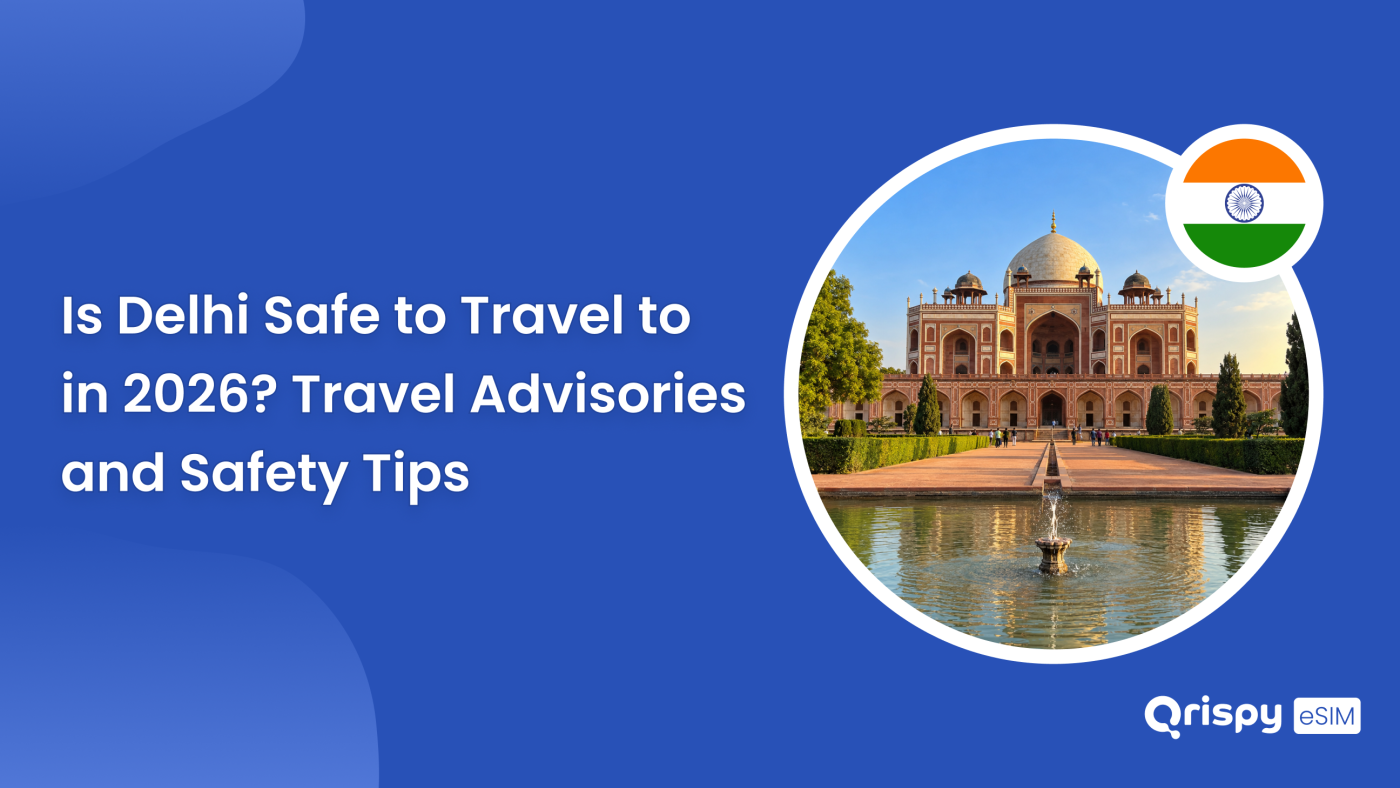
By day, Old Delhi is fine on foot: Chandni Chowk, Jama Masjid and the Red Fort are busy rather than threatening, though the lanes are tight and the crowds are real. Humayun’s Tomb, Lodhi Garden, the Qutub Minar complex and the street art of Lodhi Colony all reward walking. After dark, stick to lit main roads in areas you know, use a booked car between neighbourhoods and avoid the parkland around India Gate late at night.
Delhi safety tips that work
Most of what keeps a Delhi trip smooth is habit rather than equipment. These are the ones residents and repeat visitors actually use.
- Carry a photo of your passport and visa, plus a paper copy.
- Keep small notes so change never becomes a negotiation.
- Save your hotel address in Hindi script to show a driver.
- Note that 112 is the national emergency number across India.
- Avoid arriving at a railway station for the first time after dark.
- Buy travel insurance that covers medical evacuation, not just baggage.
eSIM for Delhi to stay connected
Connectivity is part of your safety plan here, not a luxury. A working data connection is how you book a verified car instead of accepting a stranger’s offer, how you check the pollution index, how you show a driver the correct address and how you contact someone if a plan goes wrong. Losing data in Delhi pushes you back onto exactly the interactions you were trying to avoid.
Public Wi-Fi in cafes, malls and hotels covers part of the problem, though it leaves you offline in precisely the moments that matter, standing outside a station deciding what to do next. A local SIM card gives good coverage at local rates, but Indian prepaid registration is thorough: expect to present your passport and visa, complete verification and wait, which is a poor use of your first afternoon.
Carrier roaming works instantly and costs a clear premium over local pricing, so read your daily pass terms before you fly. A travel embedded SIM (eSIM) sits between those options: you install the profile at home over Wi-Fi, it activates when you land and there is no counter to find at Indira Gandhi International Airport with luggage in tow.
The Qrispy One eSIM installs once, stays on the device permanently and works across 210+ countries and regions, which suits a longer India trip that continues to Nepal or Sri Lanka. There are 3 ways to pay on the same profile.
- Global Wallet is pay as you go, with credits that never expire and rates that vary by destination, shown before you confirm.
- Fixed Plans are prepaid for 3, 7, 15 or 30 days in a single country or region.
- Unlimited Data Plans cover 90+ countries for 3, 7, 15 or 30 days, with fair use or temporary speed management during congestion.
Keep your home SIM active for calls and one-time passcodes, set Qrispy as the mobile data line, then turn Data Roaming on for Qrispy and off for the primary line. The Qrispy line carries data only, so calls run over Wi-Fi Calling or apps such as WhatsApp. Unlimited personal hotspot is included on every plan. Travel Buddy, the in-app assistant, gives local safety and connectivity guidance alongside routing, which is useful when you are deciding whether to walk or book a car.
Setup takes under 3 minutes, with the steps laid out in the Qrispy help centre if you have not installed an eSIM before. Compare Qrispy eSIM plans for India before departure so you land already online.
Frequently asked questions
Is Delhi safe for tourists in 2026?
Yes, for most visitors taking normal big-city precautions. Petty theft, overcharging and persistent touts are the everyday realities rather than violent crime, which is rare against foreigners. Winter air pollution is the risk people underestimate most. Check your own government’s travel advice shortly before you fly, since wording changes with events.
Is Delhi safe for solo female travellers?
Yes, with more planning than most capitals require. Many women travel Delhi alone without trouble, using the women-only metro carriage, pre-booked cars after dark and accommodation in Aerocity or South Delhi. Staring and verbal harassment do happen. Dressing conservatively in older districts and sharing your live location both help considerably.
Which transport is safest in Delhi?
The Delhi Metro, comfortably. It is air-conditioned, security-screened at every station, signed in English and Hindi and reaches most places visitors want. Above ground, use Uber or Ola rather than hailing. Agree an auto-rickshaw fare before setting off. Treat crossing roads on foot as the genuine daily hazard.
When is Delhi air quality worst?
Roughly late October into January, when crop burning nearby, cooler stagnant air and traffic combine. Sensitive travellers feel it within a day or 2. Check the Central Pollution Control Board data each morning, carry a properly fitted mask, keep outdoor exercise short and pick a hotel that runs air purifiers.
Can you drink the water in Delhi?
No. Stick to sealed bottled water or water you have filtered yourself, skip ice you cannot vouch for and avoid pre-cut fruit left on display. Street food is not automatically risky: choose stalls with a queue and fast turnover, where everything is cooked in front of you and served hot.
Which areas should you avoid at night?
Quiet parkland, unlit residential lanes and the area immediately around the main railway stations are worth avoiding on foot after dark. Old Delhi is fine by day but empties oddly at night. Stay on lit main roads in districts you already know, then book a car between neighbourhoods rather than walking.
Stay connected anywhere with Qrispy eSIM
Stay connected in 210+ countries with Global Wallet, Fixed Plans and Unlimited Data. No contracts, no roaming fees, no expiry. Download the Qrispy eSIM app today and start your journey.

India Plans
Prepaid data plans for planned stays
Loading pricing plans...