


Da Nang has become the default landing spot for remote workers in Vietnam, and the reasons are practical rather than romantic: a long city beach, cheap and genuinely fast home internet, low rents by regional standards, an international airport a short ride from the sand and Hoi An down the road for weekends. The honest catch is the weather, because from roughly September to December the rain arrives properly. That is the single biggest thing to plan around.
The city sits on the central coast between Hue and Hoi An, split by the Han River. West of the water is the working city of markets, offices and older neighbourhoods. East of it are the beaches, the newer apartment blocks and the streets where most foreign remote workers end up living. Son Tra peninsula closes the bay to the north.
This guide covers where to base yourself, what the internet is actually like day to day, how coworking works here, what really drives your monthly spend, the visa mechanics and how to keep a backup connection when a deadline will not wait.
Digital nomad guide to Da Nang
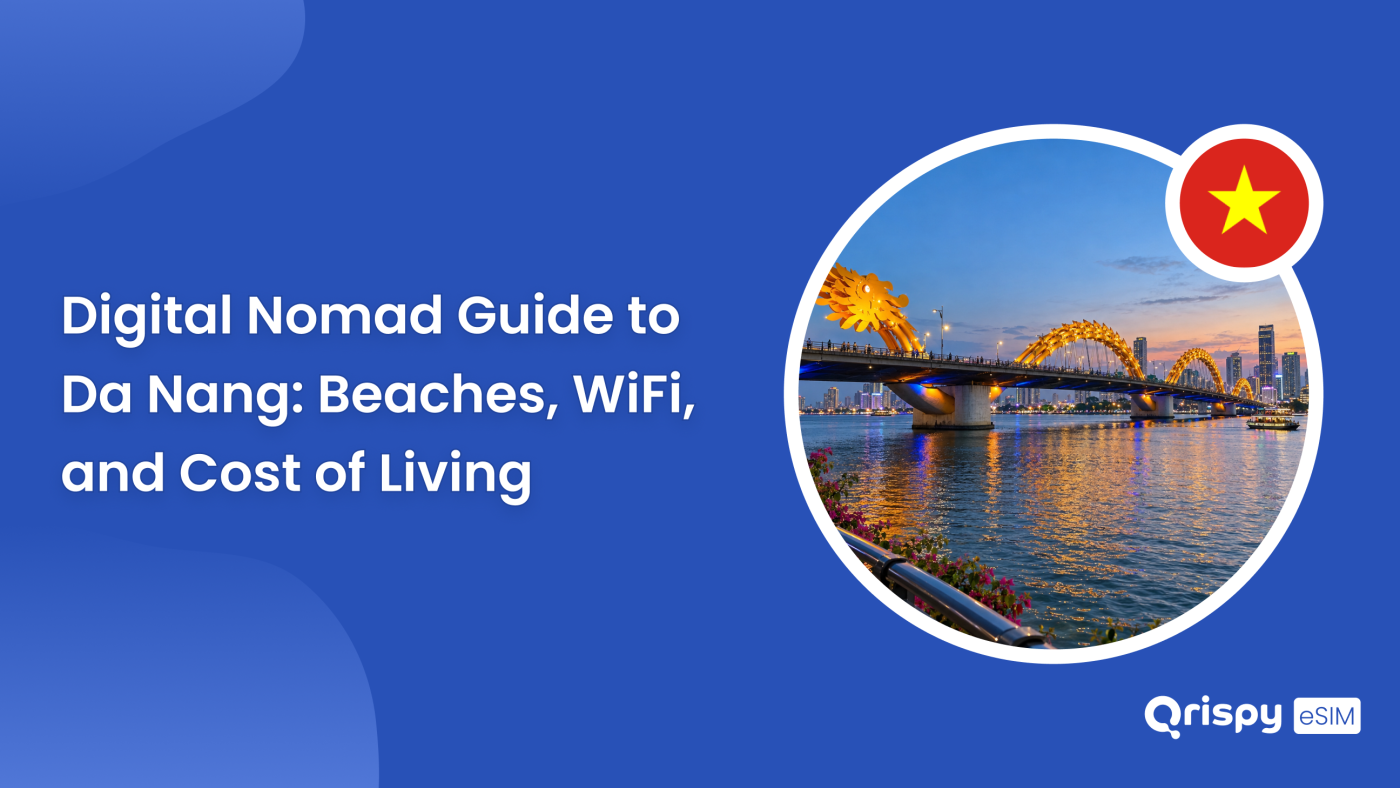
Da Nang is Vietnam’s third city and a deliberately planned one, with wide roads, bridges that light up at night and far less traffic pressure than Hanoi or Ho Chi Minh City. That calm is the main reason people stay. It is also small enough that a motorbike gets you from a beach breakfast to a meeting across the river in about 20 minutes.
- The time zone is Coordinated Universal Time (UTC) plus 7, which suits Asian and European hours far better than American ones.
- Da Nang International Airport sits inside the city with domestic and regional connections.
- The currency is the Vietnamese dong (VND), and card acceptance is now broad.
- Emergency numbers are 113 for police, 114 for fire and 115 for an ambulance.
- Hoi An is under an hour south and Hue is a scenic pass or tunnel to the north.
- Sockets take flat or round 2 pin plugs at 220 volts, so bring an adaptor.
When to go and the rainy season
Central Vietnam runs on a different calendar to the north and the south. The dry season stretches from roughly February to August, with the hottest and most humid stretch from May to August and sea temperatures that make the beach useful all day. The wet season runs from about September to December, when heavy rain, high surf and the tail end of the typhoon season arrive together. Streets in low-lying parts of the city can flood after a sustained downpour, and flights are occasionally disrupted.
Long-stay remote workers usually treat this as a rhythm rather than a problem: base in Da Nang from February to August, then move somewhere drier for the wettest weeks. If you do stay through, choose an upper floor, keep a power bank charged and expect a few days where working from your apartment is the only option.
Where to base yourself
An Thuong, the grid of small streets set back from My Khe beach, is the centre of the foreign remote working scene. It has the highest density of cafes, small gyms, coworking desks and studio apartments, and you can live there without a vehicle. My An and the streets further south towards the Marble Mountains are quieter and cheaper for the same distance from the sand.
Across the river, Hai Chau is the actual city: Han Market, Con Market, older streets, better local food and a shorter hop to the airport. It suits anyone who wants Vietnam rather than a beach suburb. Wherever you land, look at the building rather than the listing photographs, and check the water pressure and whether the road outside floods.
Internet reliability in daily use
The internet in Da Nang is one of the reasons people stay. Fibre broadband is standard in apartments and cheap by European or North American standards, cafes offer Wi-Fi as a matter of course and mobile coverage across the city and the coast road is strong. For calls, screen sharing and normal remote work, the domestic experience is comfortable.
The weakness is international routing rather than local speed. Vietnam’s traffic to the wider world runs over a small number of undersea cables, and when one develops a fault, international connections can slow noticeably for days or weeks while domestic sites stay quick. Power cuts are uncommon but not unknown, and a heavy storm can take a building offline. The practical answer is redundancy: a mobile data connection that is independent of your building, and a habit of tethering the moment a call starts breaking up.
Coworking and cafe working
Coworking in Da Nang splits into 3 useful categories. Dedicated spaces sell hot desks by the day, the week or the month, usually with meeting rooms, printing, lockers and air conditioning included, and the established ones cluster in An Thuong and in Hai Chau near the river. Cafe-coworking hybrids charge for a drink rather than a desk and are fine for a few focused hours, though power sockets and quiet vary enormously. Serviced offices suit small teams that need a lockable room and a business address.
What to check before committing to a month: whether access is genuinely 24 hours or only during staffed hours, whether the air conditioning runs in the evening, how many people share the fastest connection, whether there is a phone booth for calls and what happens during a power cut. Ask to sit for a day first. A space that is perfect at 10:00 can be unusable at 16:00 when a workshop fills the main room.
What drives your cost of living
Da Nang is usually cheaper than Ho Chi Minh City and often cheaper than Hanoi for accommodation of a similar standard, but your monthly total depends far more on how you live than on the city itself. Rather than quote figures that move with the season and the exchange rate, it helps to know which decisions actually move the number.
| Cost driver | What pushes it up | What keeps it down |
|---|---|---|
| Accommodation | Sea views, short lets, peak dry season | Monthly contracts a few streets inland |
| Food | Western menus and imported groceries | Local rice and noodle stalls, wet markets |
| Workspace | Private office or a fixed dedicated desk | Hot desk passes and cafe hours |
| Transport | Daily taxis and car hire | Monthly motorbike rental and walking |
| Visas | Frequent trips out and agent fees | Longer permitted stays arranged in advance |
| Connectivity | Roaming on your home carrier | Local data bought on a travel plan |
Just 2 habits save more than any bargain. Sign a monthly rather than a nightly agreement once you are sure of the area, because the difference is large. Then eat where the plastic stools are for most meals. Check whether electricity is billed at the residential rate or marked up by the landlord, because air conditioning through summer is the bill that surprises people.
Visas and long stay paperwork
Vietnam does not currently run a dedicated remote worker or digital nomad visa, so most people arrive on a tourist entry. The main routes are the electronic visa applied for in advance through the government portal, and visa exemption for the nationalities that hold it, which typically allows a shorter stay. Permitted lengths, single or multiple entry options and extension rules change from time to time, so treat any figure you read on a forum as out of date and check the official source.
Another 2 points matter for planning. Working remotely for a foreign employer while on a tourist entry sits in an area the rules were not written for, so anyone planning a long stay should take proper advice rather than copying a group chat. Build the cost and the interruption of leaving and re-entering into your budget if your stay will run past the permitted period.
Apply through the official Vietnamese e-visa portal rather than an agent site that adds a fee, and use the national tourism site for Vietnam for general destination information.
Beaches, mountains and weekend trips
My Khe runs for kilometres along the eastern shore and is genuinely swimmable, with lifeguard flags in season and a strong surf culture in the cooler months. Non Nuoc, further south, is quieter. Currents strengthen in the wet season, so read the flags rather than the crowd. Sunrise on the beach is a real Da Nang habit, since locals swim before work.
Inland, the Marble Mountains hold caves, pagodas and viewpoints reached by steps or a lift, and Son Tra peninsula climbs to the Linh Ung Pagoda and its towering Lady Buddha statue. Ba Na Hills and the Golden Bridge sit west of the city up a long cable car. For weekends, Hoi An is under an hour away and Hue is a train or motorbike ride over the Hai Van Pass.
Eating well every day
Da Nang has its own specialities rather than borrowing from Hanoi or Saigon. Mi Quang, the local turmeric noodle dish with pork, prawn, herbs and a shallow pool of broth, is the one to learn first. Banh xeo here comes with rice paper and a thick peanut sauce, bun cha ca is a fishcake noodle soup eaten at any hour and banh trang cuon thit heo is pork belly rolled at the table with greens. Con Market and Han Market are the places to browse, while the streets behind An Thuong mix local stalls with the cafes remote workers use as offices.
eSIM for Da Nang to stay connected
A remote worker needs a connection that does not depend on 1 building. Your apartment fibre will be good most days, and the cafes are reliable, but a dropped call during a client meeting is expensive in a way that a slow film download is not. There are 4 realistic options, and most people combine 2 of them. One of those is a travel embedded SIM (eSIM).
| Option | What it does well | What it costs you |
|---|---|---|
| Apartment fibre | Fast, cheap, fine for daily work | Tied to 1 address, and storms can take it down |
| Cafe Wi-Fi | Everywhere, no contract needed | Shared and variable, poor for sensitive work |
| Local prepaid SIM | Low cost for a long stay, local number | Passport registration, and your home SIM comes out |
| Travel eSIM | Set up before you fly, keeps your home number | Needs an unlocked, eSIM-compatible device |
Keep work traffic on mobile data rather than an open network in a busy cafe, since mobile data is the safer channel for anything sensitive. An eSIM is the least disruptive way to hold that second connection, because it lives alongside your existing line instead of replacing it.
Where Qrispy fits
Qrispy is a global eSIM provider built around a single profile called the One eSIM. Install it once, keep it on the device and use it in 210+ countries and regions, which suits anyone moving between Vietnam, Thailand and elsewhere on the same trip. You can buy data 3 ways on the same profile. The Global Wallet is pay as you go, with credits that never expire and the rate shown before you confirm. Fixed Plans are prepaid for 3, 7, 15 or 30 days with a stated allowance. Unlimited Data Plans cover 90+ countries for 3, 7, 15 or 30 days, with fair use or temporary speed management possible during heavy congestion.
For remote work specifically, 3 features matter. Unlimited personal hotspot is included on all plans, so your laptop can tether the moment the cafe Wi-Fi stutters, with usage coming off your balance or allowance. The Qrispy line carries data only rather than a phone number, so keep your usual SIM active for calls and one-time passcodes, set Qrispy as the mobile data line and turn Data Roaming on for Qrispy while leaving it off for the primary SIM. Smart IP Routing exits traffic at the nearest Qrispy Point of Presence (PoP), with Singapore the closest live site, which can make your IP address appear to sit elsewhere and sometimes affects a work login check. Start with Qrispy eSIM plans for Vietnam, and work out a realistic monthly allowance using the eSIM data usage calculator before you commit.
Frequently asked questions
Is Da Nang good for nomads?
Yes, for most people. It combines a swimmable city beach, cheap fibre internet, a settled coworking scene, low rents by regional standards and easy weekends in Hoi An and Hue. The trade-offs are a wet season from September to December and a smaller professional network than Ho Chi Minh City.
How fast is the internet?
Fast enough for video calls, screen sharing and large file transfers on a normal apartment fibre line, and cafes are generally usable. The real variable is international routing, which slows when an undersea cable develops a fault, sometimes for weeks. Keep a mobile data connection as a backup rather than relying on 1 line.
Is Da Nang cheaper than Hanoi?
Usually yes for accommodation of a similar standard, and roughly comparable for food and transport. The bigger factor is how you live: a monthly lease a few streets inland, local meals and a rented motorbike cost a fraction of short lets, Western restaurants and daily taxis. Check the electricity billing rate before signing anything.
Does Vietnam have a nomad visa?
No. There is no dedicated remote worker visa at the time of writing, so most people arrive on an electronic tourist visa applied for through the government portal, or on a visa exemption if their nationality holds one. Rules and permitted stays change, so check the official source and take advice for a long stay.
When is the rainy season?
Roughly September to December, when heavy rain, high surf and the end of the typhoon season overlap. Low-lying streets can flood after sustained downpours and flights are occasionally disrupted. February to August is the dry stretch, hottest from May onwards. Many long-stay workers simply move elsewhere for the wettest weeks.
Do you need a motorbike?
Not if you live in An Thuong, where daily life is walkable and ride-hailing apps cover the rest. A monthly motorbike rental transforms the city, opening up Son Tra, the Marble Mountains and Hoi An. Check what licence and insurance you need before riding, and wear a proper helmet rather than a token one.
Stay connected anywhere with Qrispy eSIM
Stay connected in 210+ countries with Global Wallet, Fixed Plans and Unlimited Data. No contracts, no roaming fees, no expiry. Download the Qrispy eSIM app today and start your journey.

Vietnam Plans
Prepaid data plans for planned stays
Loading pricing plans...