


You are on a Vodafone contract in the United Kingdom (UK), you have a trip booked and you want to know whether to lean on the roaming that comes with your plan or buy a travel embedded SIM (eSIM) instead. Here is the short answer. If your destination sits inside the zone your plan already includes and you are away for a few days on light usage, roaming is the simpler option and you can stop reading. If you are heading beyond that zone, staying longer than a week or working from your phone, a travel eSIM usually costs less per gigabyte (GB) and gives you far more control over what you spend.
Neither answer is universal, because the 2 options are priced on completely different logic. Vodafone charges you for access: either a daily or multi-day pass or an inclusion baked into your tariff, with a fair-use allowance sitting quietly behind it. A travel eSIM charges you for data: either a balance you draw down at a published rate or a fixed allowance for a set number of days. Once you frame the choice that way, the maths stops being mysterious.
This guide covers how Vodafone structures roaming, what a travel eSIM changes, how to compare the 2 without guessing at prices and the setup steps that differ between iPhone and Android.
How Vodafone structures roaming abroad
Vodafone, like every UK network, sells international access by geography. Destinations are grouped into zones. The zone your destination sits in decides whether your allowance travels with you free of charge, whether you need to buy a pass and how much that pass costs per day. Nothing about that structure is unusual. What catches people out is that the zone list changes and the destination you assumed was covered may no longer be.
Underneath the zones sit 3 mechanisms worth understanding before you travel.
- Inclusive roaming, where your normal UK allowance works in a named list of destinations at no extra cost, usually with a separate roaming data limit that is lower than your full monthly allowance.
- Roaming passes, bought per day or as a longer block, which unlock your allowance in destinations that are not inclusive on your tariff.
- Standard out-of-zone rates, which apply per unit of data when you use your phone somewhere no pass and no inclusion covers. These are the source of almost every shocking bill.
Charging starts the moment your handset registers on a foreign network, not when you open an app. A phone that syncs email in the taxi from the airport has already begun the billing day. That is why the setup section below matters more than any price comparison.
What to check on your own tariff
Open the My Vodafone app or sign in on the website, find the roaming section and check 4 things for your specific destination and dates: whether the country is inclusive on your plan, what a pass costs per day if it is not, what the roaming data limit is once you are connected and whether a spend cap is switched on. Vodafone publishes the current zones, passes and allowances on its global roaming pages. Those pages are the only version of the truth on the day you fly.
Pay particular attention to the fair-use limit attached to inclusive roaming. Inclusive rarely means unmetered. It usually means a capped number of gigabytes abroad, after which you are charged per unit or throttled. The cap is often well below what a fortnight of maps, video calls and hotel-free evenings will consume.
What a travel eSIM changes
A travel eSIM is a second mobile profile downloaded onto your phone, sitting alongside the Vodafone SIM rather than replacing it. Your Vodafone number stays live for calls, texts and the security passcodes your bank sends. The travel profile carries data only. You choose which line the phone uses for mobile data. Nothing is swapped, nothing is posted to you and nothing needs a shop visit.
Because the travel profile is a separate account, the cost is visible and finite. You either hold a balance and watch it fall or buy a fixed allowance for a fixed number of days. There is no post-trip bill, no surprise item on the next direct debit and no dependence on a pass renewing itself correctly at midnight in a different timezone.
The trade-off is worth stating plainly. A data-only travel profile does not carry your UK number, so anyone dialling you still reaches your Vodafone line, which is what you want as long as that line is set not to use data abroad. Calls go over Wi-Fi Calling on the primary line or over apps such as WhatsApp and FaceTime.
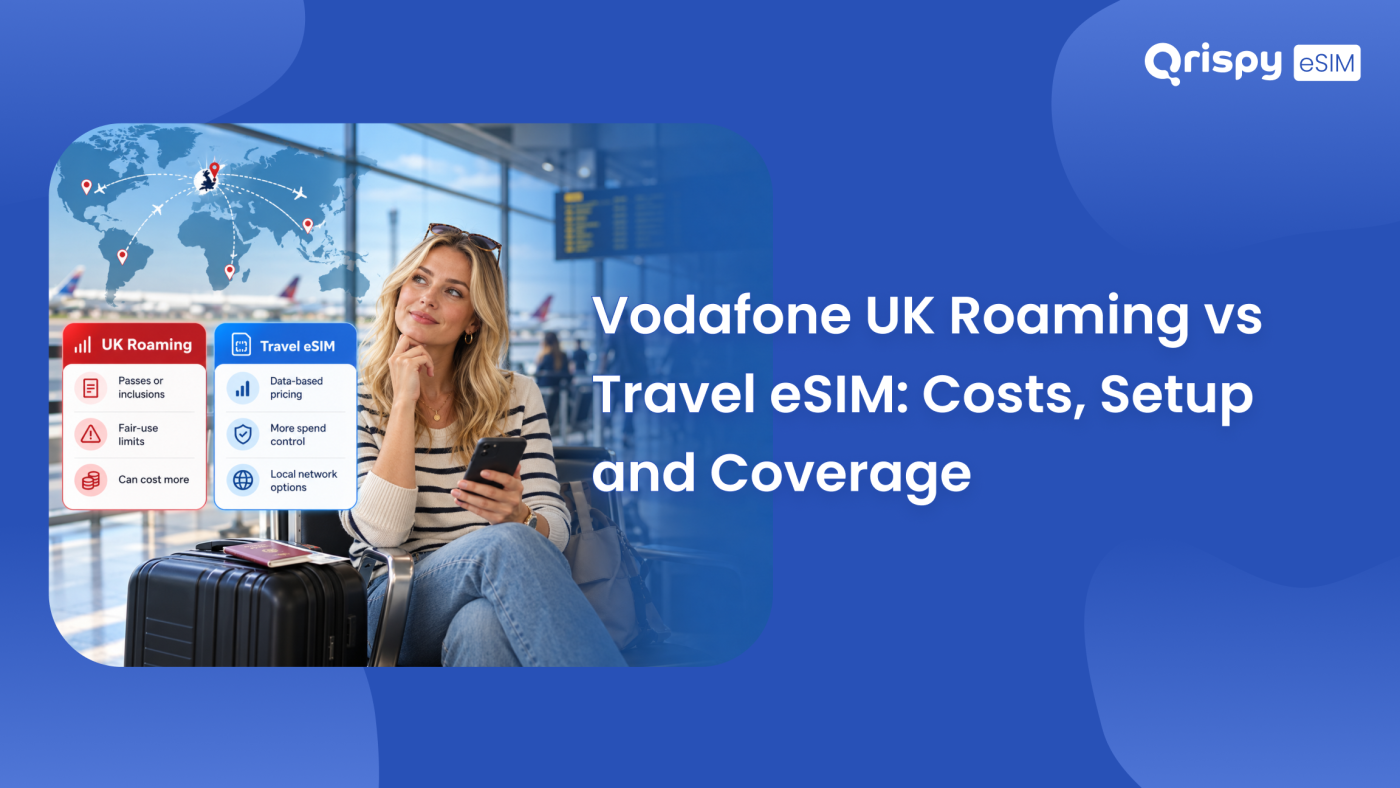
Vodafone UK roaming vs travel eSIM
Set side by side, the 2 options differ on cost logic, coverage breadth and how much attention they demand from you. This table compares the structure of each option rather than the price, because prices move and structures do not.
| What you are comparing | Vodafone roaming | Travel eSIM |
|---|---|---|
| What you pay for | Access, by day or by inclusion | Data, by balance or by allowance |
| Where it works | The zones your tariff or pass covers | The countries the provider lists, often far wider |
| Cost outside that list | Standard per-unit rates apply | Buy a plan for the new country instead |
| Your UK number | Stays active and reachable | Stays active on the primary SIM |
| Setup before departure | Check the zone, buy a pass if needed | Install the profile, set the data line |
| Spend visibility | Appears on the next bill | Paid before you travel |
| Running out | Charged on, throttled or capped | Top up in the app in seconds |
A long weekend in a covered destination barely stresses either column. A 3 week trip crossing 4 countries, half of them outside the inclusive zone, tilts the answer decisively.
Comparing the cost without guessing
You cannot compare a daily access fee with a per-gigabyte rate until you know roughly how much data you use. Check your last full month in Settings on the phone, halve it if you plan to be sightseeing rather than commuting, then add headroom for maps and video calls. The Qrispy eSIM data usage calculator turns daily habits into a sensible gigabyte figure in under a minute.
Then run 3 sums. Multiply the daily pass cost by the number of days you will be abroad, counting the departure day and the return day, because both usually count. Multiply your estimated data need by the travel eSIM rate. Compare both against the standard out-of-zone rates you would pay by doing nothing. Whichever number is lowest, sanity-check it against the fair-use limit: a cheap pass that caps you on day 4 of 10 is not cheap.
Setting up your phone before you fly
Half the horror stories are configuration failures rather than pricing failures. The goal is the same on every device: the Vodafone line stays available for calls and texts with its data roaming switched off while the travel profile handles data.
iPhone steps and exact labels
Open Settings, then “Mobile Service”, which appears as “Mobile Data” on older versions of iOS. Tap your Vodafone line and set “Data Roaming” to off. Return to the previous screen, tap the travel eSIM line and set its “Data Roaming” to on, because a travel profile is technically roaming in the country you are visiting and will not connect without it. On the same “Mobile Service” screen, set “Mobile Data” to the travel line and set “Default Voice Line” to Vodafone. Finally, turn “Mobile Data Switching” off so the phone cannot quietly fall back to the Vodafone line for data.
Android steps and exact labels
On a Pixel, open Settings, tap the network and internet section, then “SIMs”. Select the Vodafone entry and turn “Roaming” off. Select the travel eSIM entry, turn “Mobile data” on and turn “Roaming” on. On a Samsung Galaxy, lines are managed in Settings, then “Connections”, then “SIM manager”, where you set which SIM is used for “Mobile data”, while the roaming control sits in Settings, then “Connections”, then “Mobile networks”, then “Data roaming”. Labels shift a little between manufacturers and Android versions, but the pattern never changes: 1 line for voice, 1 line for data, roaming allowed only on the travel profile.
Coverage and network quality abroad
Roaming and travel eSIMs both borrow local networks, so the real question is how many each option can reach. A carrier roaming agreement typically hands you a single partner network per country. If that partner is weak where you stand, you wait. A multi-network travel profile can hold agreements with several operators in the same country and move between them.
Check your destination’s realities too. Mountain regions, rural coastlines and older metro systems expose gaps that a city break never reveals.
Where Qrispy fits in the comparison
Qrispy is a global eSIM provider whose One eSIM installs once and stays on your device, working across 210+ countries and regions. It is built for exactly the gap this article describes: the trip that leaves the inclusive zone, runs longer than a pass makes sense for or crosses several countries in 1 itinerary. The catalogue runs both ways, so the Qrispy eSIM plans for the United Kingdom cover a second device at home or a visitor arriving on a foreign contract.
You can buy data in 3 ways on the same profile, which maps neatly onto the comparison above.
- Global Wallet is pay as you go, with credits that never expire and rates that vary by destination, shown before you confirm, whether you are buying for Europe or further afield.
- Fixed Plans are prepaid for 1 country or region, in durations of 3, 7, 15 or 30 days with a stated allowance, which is the closest equivalent to a roaming pass.
- Unlimited Data Plans cover 90+ countries for 3, 7, 15 or 30 days with no data cap, though fair use or temporary speed management can apply during very heavy usage or congestion.
Unlimited personal hotspot is included on all plans, with usage deducted from your balance or allowance. Traffic exits at the nearest Qrispy Point of Presence (PoP) through Smart IP Routing for lower latency. A consequence worth knowing before you travel is that your IP address may appear to be in a different country, which does not affect coverage or data use but can affect geo-restricted streaming and some login checks, which matters if you plan to watch UK television abroad. Before you buy anything, run your handset through the eSIM device compatibility checker, because a locked or older phone cannot use any travel eSIM.
Which option suits your trip
- Choose Vodafone roaming for short trips inside your inclusive zone, when you want your UK number handling everything and nothing to configure.
- Choose a travel eSIM for longer trips, multi-country itineraries, destinations outside the inclusive zone or any trip where you will work from the phone.
- Choose both, deliberately, if you want the Vodafone line for calls and texts and the travel profile for all data, which is what most frequent travellers settle on.
- Avoid the accidental third option, which is arriving with nothing arranged and paying standard out-of-zone rates for a fortnight.
Frequently asked questions
Can I keep my Vodafone number?
Yes. The travel eSIM is an additional profile, not a replacement, so your Vodafone SIM stays registered for calls and texts. Set the travel profile as the mobile data line and switch data roaming off for the Vodafone line. Incoming calls and bank passcodes still arrive normally while you avoid paying roaming rates for background data.
Does a travel eSIM need unlocking?
No. Any eSIM, from any provider, needs an unlocked and eSIM-compatible handset. Devices bought outright are usually unlocked already, while some contract or pay-as-you-go handsets are not. Ask Vodafone to unlock the device before you travel, then confirm the model supports eSIM using a compatibility checker rather than assuming.
Will I be charged twice?
No, provided your Vodafone line has data roaming turned off. Charges only start when a line actually uses data on a foreign network. A line that is registered for calls and texts alone does not consume roaming data, though a call you make or receive abroad is still billed at the applicable voice rate.
How much data for 2 weeks?
Most travellers use less than they fear, because hotel and cafe Wi-Fi absorbs the heavy work. Maps, messaging and social media are modest consumers, while video streaming and long video calls are not. Estimate your daily habits, add roughly 30% headroom and prefer a plan you can top up over a plan you have to overbuy.
Does either option work on a cruise?
Neither behaves normally at sea. Ship-based networks are satellite services billed separately from ordinary roaming. A travel eSIM connects only when the vessel is close enough to shore for a land network. Plan around port days, use the ship’s own package if you truly need connectivity between ports and keep data roaming off in open water.
Stay connected anywhere with Qrispy eSIM
Stay connected in 210+ countries with Global Wallet, Fixed Plans and Unlimited Data. No contracts, no roaming fees, no expiry. Download the Qrispy eSIM app today and start your journey.

United Kingdom Plans
Prepaid data plans for planned stays
Loading pricing plans...